
- Início
- ¿Quem somos?
- Notícias
- Eventos
- EXPORTAR Exportar
- COMPRAR Comprar
-
INVESTIR
Investir
Investir
- MARCA PAÍS Marca País
-
PORTAL DE INFORMAÇÕES
Portal de informações
Portal deInformaçõesPortal deInformaçõesRelatórios Documentos de trabalho Estudos de comércio exterior Estudos de países Estudos departamentais Estudos setoriais Fichas Produto-DestinoInformação estatística Classificação Uruguay XXI Esforço Nacional Innovador Exportações Importações Monitor Macroeconômico Ferramentas Compradores Exportadores Investidores
- Contato
-
Línguas
A Marca País forneceu ferramentas às suas empresas licenciadas para que apliquem a identidade visual do Uruguai
O evento apresentou orientações para a integração do certificado em produtos, comunicações e ações comerciais
 Data de publicação: 18/11/2026
Partilhar:
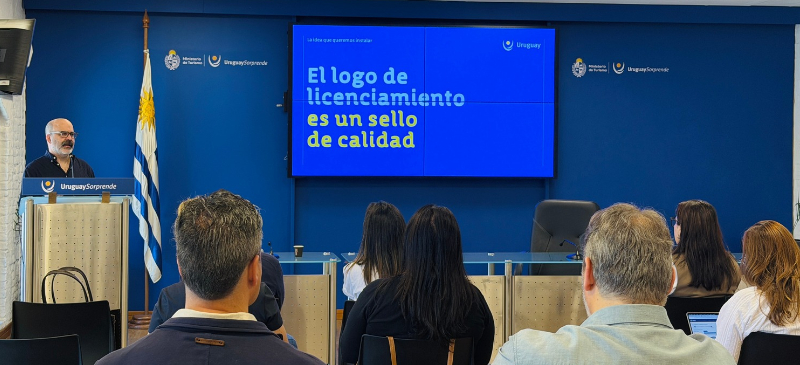
Marca País held a hands-on workshop for licensees to explore in greater depth the use and application of Uruguay’s visual identity. The event, held in the Arredondo Room at the Ministry of Tourism, brought together representatives from companies in various sectors—both in person and virtually—to learn about best practices and tools that will enable them to leverage the value of the license in their communication and positioning strategies.
The event featured Nicolás Branca, Director of R&D Design and head of the visual identity for Marca País Uruguay, who presented the brand’s fundamentals, its evolution, and key recommendations for applying it to products, services, and communication materials.
During the opening remarks, Larissa Perdomo, Country Brand Manager at Uruguay XXI, emphasized the importance of companies incorporating the logo into their communications. She explained that using the logo highlights the endorsement associated with the certification process and, at the same time, helps strengthen Uruguay’s identity and recognition. In this regard, she noted that applying the brand benefits both companies and the country’s positioning.
A Collectively Built Identity
Branca reviewed the journey of the Country Brand from its origins in the early 2000s to its consolidation as an identity that unites different productive sectors, institutions, and companies under a single symbol.
During his presentation, he emphasized that a brand’s strength does not depend solely on its graphic representation, but on the values, experiences, and trust it builds over time.
“There is something that cannot be copied because it is built over time, and that is trust,” Branca stated, explaining the importance of brands and verifiable seals in a context of growing competition and digitalization.
He also underscored the collective nature of Marca País Uruguay and the mutually beneficial relationship between the companies that use its identity and the country’s international reputation. From this perspective, he explained that focusing efforts on a common identity helps strengthen its recognition and consistently project Uruguay’s attributes.
From the Seal to Corporate Communications
The session included specific recommendations for integrating the Country Brand into packaging, labels, catalogs, websites, social media, business presentations, trade shows, and other media.
Branca explained the importance of using the official files, adhering to the proportions, colors, and versions specified in the brand manual, and maintaining visual consistency across different applications.
He also proposed alternatives for products where it is not possible to incorporate the seal directly, such as using it on secondary packaging, promotional materials, or communications aimed at international customers.
In this context, he emphasized that the Country Brand can provide companies not only with visual recognition but also with talking points to communicate their origin and attributes. “The Country Brand is not just a seal; it can also be a source of content,” he noted.
The meeting concluded with a Q&A session in which participants asked questions about the use of the seal on digital platforms, in advertising campaigns, on vehicles, and in corporate materials. Germán Amorín, head of Marca País licensing, reiterated the importance of having applications approved by the agency to ensure compliance with established guidelines.
The event continued the ongoing support provided to licensed companies. In June, Marca País had held another workshop to present Uruguay XXI’s tools, programs, and services designed to strengthen Uruguayan companies’ internationalization processes and export development.