
- Home
- About us
- News
- Events
- EXPORT Export
- BUY Buy
- INVEST Invest
- COUNTRY BRAND Country Brand
-
INFORMATION CENTER
Information center
InformationCenterInformationCenterReports Country reports Department reports Foreign trade reports Product-Destination worksheet Sectors reports Work documentsStatistical information Classification Uruguay XXI Exports Imports Innovative National Effort Macroeconomic Monitor Tools Buyers Exporters Investors
- Contact
-
Languages
Companies in Rivera and Tacuarembó Eye New Markets Following Más Comercio Events
MSMEs and entrepreneurs in northern Uruguay learned about support programs to help them expand into international markets
 Publication date: 19/08/2026
Share:
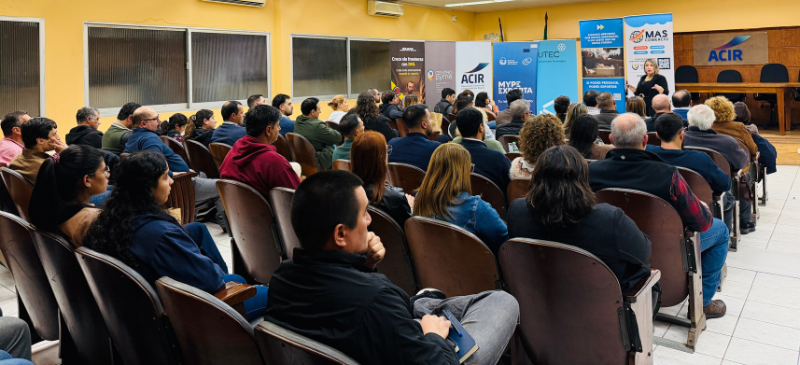
Más Comercio made two stops in northern Uruguay as part of its 2026 program, with events in Rivera and Tacuarembó. At both events, Uruguay XXI provided small businesses and entrepreneurs with practical tools to understand the first steps involved in exporting, learn about available support programs, and access personalized mentoring.
In Rivera, the event was held at the Centro Pyme (SME Center) and focused on the business environment of a department located along Uruguay’s border with Brazil.
Rivera Intendant Richard Sander Darín highlighted the program’s regional reach. Más Comercio was formally designated an initiative of departmental interest by the Rivera government. Sander emphasized that the program helps “decentralize all the information that is normally concentrated in the capital” and make it accessible to businesses outside Montevideo. He also stressed the importance of giving small business owners access to information and support tools that can help them make decisions and compete in an economy closely connected to Brazil.
Sander also highlighted the value of coordination among the Rivera Departmental Government, the Centro Pyme, Uruguay XXI, and other organizations that support businesses. “You can’t do anything alone. I’m convinced of the importance of collaboration among institutions,” he said, adding that providing small and medium-sized businesses with more resources can broaden their opportunities.
Participants’ experiences also showed how this support can translate into concrete next steps. Tomás and Gustavo Vega, from the Rivera Beekeepers’ Cooperative, highlighted the information and guidance they received during the event. “It was a truly worthwhile experience, and we left with a lot of work to do,” Gustavo said.
Wilson de Lima, co-owner of gourmet alfajores company Hemels, also described a shift in perspective after learning about the tools available. “Exporting doesn’t seem difficult to me. I think it’s quite a bit simpler than I thought,” he said. At the same time, he identified challenges such as extending the shelf life and improving the packaging of the company’s alfajores before moving into international markets.
Facundo Dutra, from Pastas Tito, attended with his father to explore opportunities to enter the Brazilian market, where the company is already seeing interest in its products as a result of cross-border demand. Dutra said the workshop introduced them to support programs and resources they had not previously known about and noted that these initiatives provide “all the guidance needed to avoid making missteps” in a process that requires time and preparation.
In Tacuarembó, the personalized mentoring sessions included three local businesses: Agua Rural, represented by Joaquín Pirez and Felipe Pirez; Forest Tree SRL, represented by José Gregorio Rodríguez; and Molletitos del Buen Paladar, represented by Alejandro Rodríguez. Their participation reflected the program’s focus on providing businesses with direct access to tailored guidance as they assess their potential and prepare for future growth in international markets.
Rivera recorded approximately US$157 million in goods exports last year, led by timber and timber products, soybeans, and rice. In Tacuarembó, goods exports reached approximately US$682 million, with beef, timber and timber products, meat byproducts, rice, and soybeans among the leading categories.
The program’s next event will take place on October 15 in Montevideo, with the first Más Comercio Mujeres edition. The event will continue the 2026 program and its strategy of bringing export support, practical tools, and internationalization opportunities closer to businesses.