
- Home
- About us
- News
- Events
- EXPORT Export
- BUY Buy
- INVEST Invest
- COUNTRY BRAND Country Brand
-
INFORMATION CENTER
Information center
InformationCenterInformationCenterReports Country reports Department reports Foreign trade reports Product-Destination worksheet Sectors reports Work documentsStatistical information Classification Uruguay XXI Exports Imports Innovative National Effort Macroeconomic Monitor Tools Buyers Exporters Investors
- Contact
-
Languages
Epic Aerospace Expands Its Investment in Uruguay, Adding New Space Industry Capabilities
The expansion adds advanced assembly and testing technology and strengthens Uruguay’s space industry value chain
 Publication date: 01/09/2026
Share:
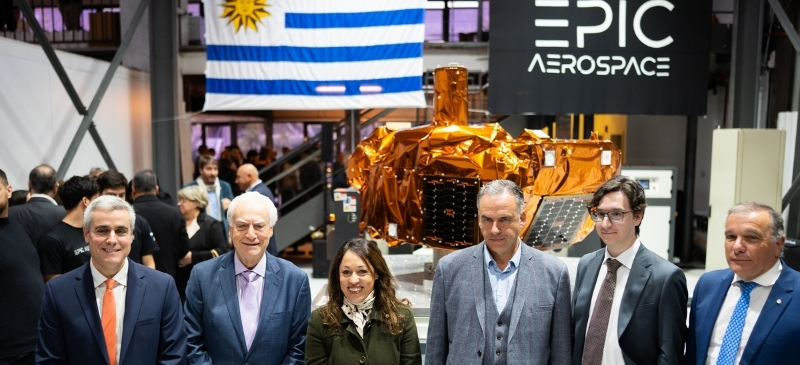
Epic Aerospace, a US aerospace company founded by Argentine engineer Ignacio Belieres Montero, has expanded its investment in Uruguay with the opening of new facilities at Zonamerica. The company manufactures, assembles, and tests orbital transfer vehicles at the site, incorporating specialized technology and deepening Uruguay’s participation in a knowledge-intensive global value chain.
The expansion includes a 300-kilonewton vibration testing system capable of testing satellite equipment weighing up to 2,500 kilograms. The new infrastructure enables space vehicles to be manufactured, assembled, and validated in Uruguay using capabilities comparable to those available at the space agencies of Brazil and Argentina.
The equipment was acquired with support from the National Agency for Research and Innovation (ANII) through the Orestes Fiandra Trust. The inauguration, held on August 27, was attended by President Yamandú Orsi; Minister of Industry, Energy, and Mining Fernanda Cardona; officials from ANII, Uruguay XXI, and Zonamerica; and representatives of the technology sector.
The company also unveiled the Chimera GEO 2, a 780-kilogram orbital transfer vehicle designed to carry payloads into geostationary orbit. According to information presented at the event, the technology will provide Uruguay with space transportation capabilities that are not currently available elsewhere in Latin America and could significantly reduce the cost of certain missions.


The new facilities expand the manufacturing, integration, and testing operations that Epic Aerospace was already conducting in Uruguay. The project joins other international investments in the sector, including Satellogic, which has operated at Zonamerica since 2015 and manufactures, assembles, integrates, and tests satellites there. Together, these investments strengthen local capabilities in advanced manufacturing and knowledge-intensive services while demonstrating Uruguay’s potential as a base for developing technology for international markets.
Orsi highlighted Uruguay’s progress in space technology manufacturing and testing and identified the continued expansion of these capabilities as a key challenge.
Cardona described the inauguration as an important step in Uruguay’s space policy and emphasized its potential to create jobs, support productive development and innovation, and incorporate local components and expertise. The minister noted that these capabilities build on the country’s experience in telecommunications, infrastructure, energy, and academic education. She also said that Uruguay is developing a dedicated regulatory framework for the sector.
For Uruguay XXI, investments of this kind contribute to a broader strategy of strengthening local capabilities and integrating companies into new global value chains. During the event, Alejandro Ferrari, Investment and Aftercare Manager, highlighted the importance of advancing the regulatory framework, supporting science and research, and creating the conditions for the ecosystem to scale.
Epic Aerospace’s investment also forms part of Uruguay’s internationally oriented technology economy. In 2024, the country’s ICT sector recorded US$2.323 billion in international sales, equivalent to 63% of its total revenue, while 76% of companies reported sales to international customers.
Projects involving greater technological complexity broaden this foundation and reinforce Uruguay’s position as a platform for investing in, developing, and testing technology for global markets.