
- Home
- About us
- News
- Events
- EXPORT Export
- BUY Buy
- INVEST Invest
- COUNTRY BRAND Country Brand
-
INFORMATION CENTER
Information center
InformationCenterInformationCenterReports Country reports Department reports Foreign trade reports Product-Destination worksheet Sectors reports Work documentsStatistical information Classification Uruguay XXI Exports Imports Innovative National Effort Macroeconomic Monitor Tools Buyers Exporters Investors
- Contact
-
Languages
Food and Beverage Matchmaking Connects 80 Uruguayan Firms with 18 Buyers from Eight Markets
Uruguay XXI and the CIU organized more than 400 meetings in Montevideo to generate new business opportunities
 Publication date: 07/08/2026
Share:
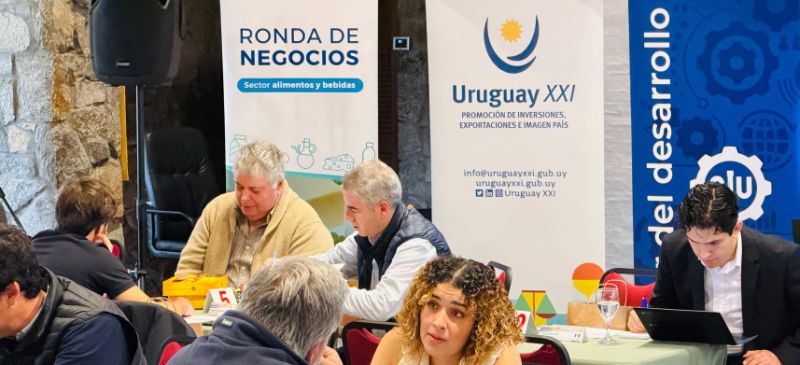
An international business matchmaking event organized by Uruguay XXI and the Chamber of Industries of Uruguay (CIU) connected 80 Uruguayan food and beverage companies with 18 buyers from Argentina, Brazil, Colombia, Mexico, Paraguay, Peru, Ecuador, and the United States. Held August 4–5 at the Club de los Industriales in Montevideo, the event featured more than 400 scheduled business meetings.
Over the two days, exporters and companies beginning to explore international markets held 30-minute, one-on-one meetings with representatives of supermarket chains, importers, and distributors. The meetings were arranged in advance based on each Uruguayan company’s product portfolio and buyers’ sourcing needs, with the aim of facilitating commercial contacts and identifying potential deals.
The initiative is part of a partnership of more than a decade between Uruguay XXI and the CIU.
Uruguay’s participation reflected the diversity of the country’s food and beverage sector. The products presented included wines, dairy products, baked goods, snacks, beverages, frozen foods, superfoods, and gluten-free products, among other categories. Companies with an established presence in international markets participated alongside firms seeking to export for the first time, bringing together products with a proven export track record and more recently developed offerings.
The agenda began with a presentation by Analía Bello, Uruguay XXI’s food export specialist, on the characteristics of Uruguayan production and the opportunities arising from international market trends. Bello explained that Uruguay exports to more than 160 markets, with food products reaching 140 of them. With a population of 3.5 million, the country exports enough food to feed 30 million people and has the potential to supply another 20 million. She also highlighted the companies’ experience with food safety controls, certifications, traceability, and meeting the requirements of international buyers. “Trust is built on evidence,” she said.
The interests expressed by buyers revealed opportunities in both traditional categories and more specialized segments. Marcio Gomez, import manager for the Brazilian supermarket chain Angeloni, explained that the company has purchased cheese, butter, wine, dulce de leche, and meat from Uruguay for years. “My customers love Uruguayan products. They are very high quality, especially the dairy products,” he said. Gomez also praised the readiness of Uruguayan companies to do business and noted that the event allowed him to seek new suppliers of beef and lamb, ready meals, and dulce de leche.
Jaime Gutierrez Ballón, commercial manager at DIVOC, arrived from Peru with a 14-year business relationship with Uruguay and an interest in adding superfoods and cheeses to his portfolio. “In my experience, Uruguayan businesspeople are very reliable,” he said. Gutierrez found a more developed selection of superfoods than he had expected and said that, compared with products from the United States, Argentina, and Europe, “some categories can be internationally competitive.”
Diana Carolina Ruiz, commercial manager at Vivaldi Global, identified opportunities in healthy foods, finished products for consumers with dietary restrictions, cookies, baked goods, and alfajores. “These are very good, high-quality products that compare favorably with those from other countries. They also stand out for their creativity,” she said. Following her initial meetings, Ruiz noted that several offerings met Vivaldi’s criteria for innovation, price, shelf life, and consumer convenience. She also expressed interest in adding Uruguayan brands to the company’s distribution portfolio.
Beyond the products themselves, buyers highlighted Uruguay’s favorable conditions for developing business relationships. They pointed to the quality of its raw materials, the track record of its food industries, the readiness of companies of different sizes, and the ease of doing business, supported by trade agreements, geographic proximity, and competitive delivery times. The availability of retail-ready healthy foods also generated interest. According to Ruiz, “It isn’t easy to find manufacturers of this kind of product.”
The event generated follow-up plans, potential suppliers to evaluate, and products requiring further review of pricing, logistics, and market-access requirements. The next stages of these discussions will determine which contacts lead to business deals and whether Uruguayan food products gain access to new channels and markets.