
- Home
- About us
- News
- Events
- EXPORT Export
- BUY Buy
- INVEST Invest
- COUNTRY BRAND Country Brand
-
INFORMATION CENTER
Information center
InformationCenterInformationCenterReports Country reports Department reports Foreign trade reports Product-Destination worksheet Sectors reports Work documentsStatistical information Classification Uruguay XXI Exports Imports Innovative National Effort Macroeconomic Monitor Tools Buyers Exporters Investors
- Contact
-
Languages
Uruguay XXI presented export tools at the “Women Entrepreneurs Creating Value” event
The Agency's Executive Director discussed export opportunities and gender gaps at the Rural del Prado conference
 Publication date: 22/09/2026
Share:
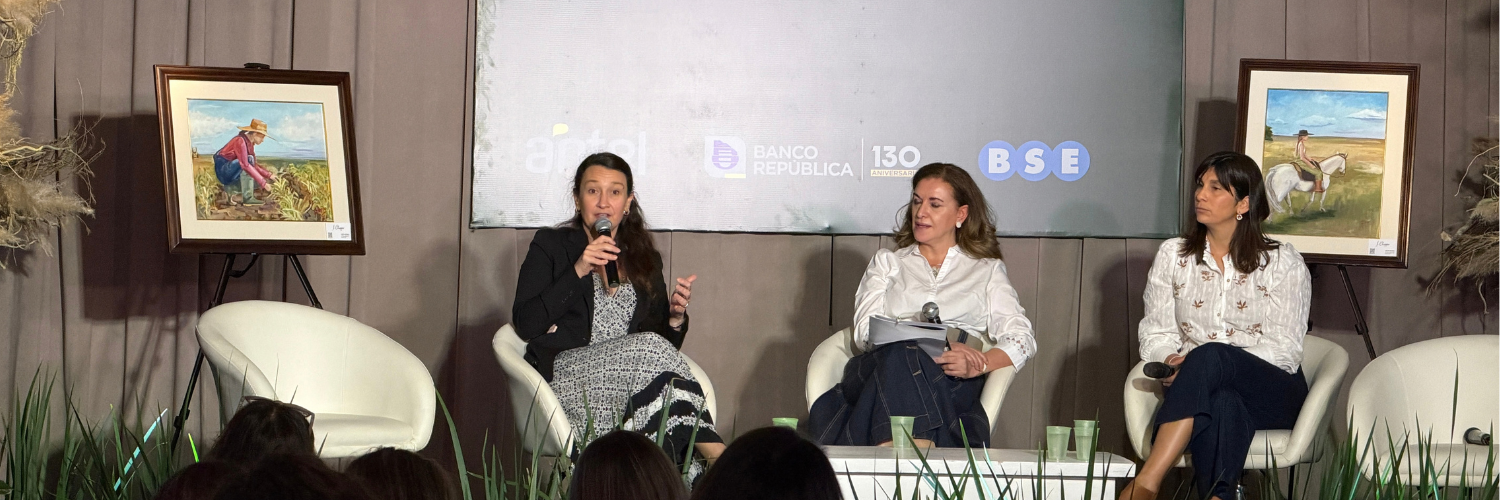
Opportunities for more Uruguayan companies to access international markets and the challenges faced by women entrepreneurs were the focus of the remarks by Uruguay XXI Executive Director Mariana Ferreira at the third edition of Empresarias Transformando Valor, held at La Rural del Prado.
The event, organized by the Uruguay Chapter of the Mercosur Women’s Business Convergence (CEMM), aimed to highlight the impact of women on the country’s economic and social development. Ferreira was part of the panel “Uruguay Facing the New International Landscape: Opportunities to Produce, Invest, and Export,” alongside Undersecretary of Foreign Affairs Valeria Csukasi, with Anabela Aldaz serving as moderator.
During the panel discussion, Csukasi highlighted the cross-cutting scope of the Mercosur-European Union Agreement and the need for its benefits to be available to women seeking to expand internationally. “This agreement has the advantage of offering opportunities for everyone, in all areas of the economy,” she stated. “There is no product that cannot benefit, no service that cannot benefit,” she added. She also identified Spain as a potential gateway to the European market, given the cultural proximity, the language, and familiarity with Uruguayan products.
During her remarks, Ferreira emphasized that the Mercosur-European Union Agreement opens new prospects both for attracting investment and for Uruguayan export companies. She noted that the agreement lays the groundwork for European companies and business groups to identify opportunities in Uruguay, and mentioned inquiries received from Spain, Italy, and Germany.
In this context, he noted that micro, small, and medium-sized enterprises (MSMEs) account for more than 85% of Uruguayan exporting companies but represent only 5% of the total export value. “That is where we see the main opportunities for exporting SMEs,” he said. He also indicated that the agreement can help these companies increase their foreign sales and diversify their export destinations, which are currently concentrated mainly within the region.

Tools to Close the Gaps
Women’s participation in business leadership was another key topic. Ferreira noted that less than 15% of companies that export goods and services have women in leadership positions. She also identified additional barriers related to market access, caregiving responsibilities, and access to financing. However, she emphasized that the European Union can represent an opportunity for women-led businesses, as it is a fairly open market with a shared agenda on human rights and women’s participation.
In this context, she emphasized the importance of providing female entrepreneurs with information and support to advance their internationalization efforts. Ferreira presented the Mercosur-European Union Agreement Portal, a tool developed by Uruguay XXI that allows users to look up tariffs, rules of origin, quotas, and requirements for accessing the European market, and invited participants to use it to explore new export opportunities.
The portal allows users to search for products without knowing their tariff code in advance and brings together commercial, regulatory, and market intelligence information in a single space. It also includes the necessary documentation, sanitary, phytosanitary, and technical requirements, and a guide that summarizes the export process in six steps, with the aim of facilitating decision-making for companies.