
- Home
- About us
- News
- Events
- EXPORT Export
- BUY Buy
- INVEST Invest
- COUNTRY BRAND Country Brand
-
INFORMATION CENTER
Information center
InformationCenterInformationCenterReports Country reports Department reports Foreign trade reports Product-Destination worksheet Sectors reports Work documentsStatistical information Classification Uruguay XXI Exports Imports Innovative National Effort Macroeconomic Monitor Tools Buyers Exporters Investors
- Contact
-
Languages
Uruguay Opens National Artificial Intelligence Center and Strengthens Its Technology Ecosystem
The Vidart Institute will bring together science, talent, and businesses to turn AI into high-value solutions
 Publication date: 16/09/2026
Share:
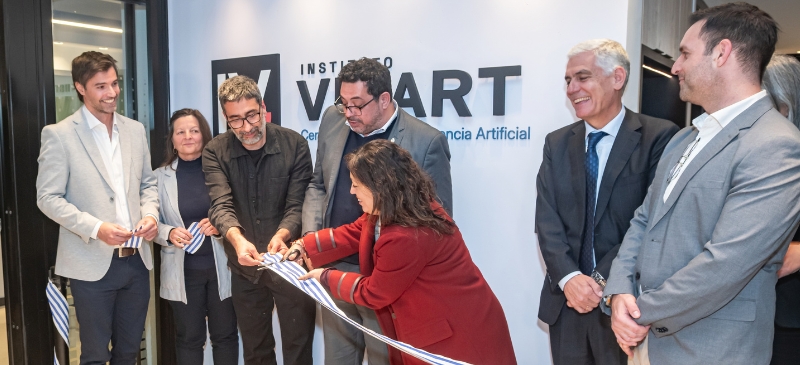
Uruguay launched the Vidart Institute, its National Artificial Intelligence Center, an initiative aimed at generating cutting-edge knowledge, training talent, and promoting technology transfer among academia, the government, and the private sector.
The new center will operate at the Innovation Park of the Technological Laboratory of Uruguay (LATU). Its creation strengthens the capabilities of the national science, technology, and innovation ecosystem and establishes a specialized environment for transforming research into concrete, high-value applications.
It will connect the research capabilities of universities with technology companies and public agencies, with the goal of accelerating innovation, driving prototype development, and facilitating the integration of artificial intelligence into various sectors of the economy and society.
“The Vidart Institute arrives at a time when our ecosystem has reached a stage of maturity, positioning itself as a bridge between knowledge and real-world application,” stated its executive director, Diego Garagorry. He emphasized that Uruguay possesses the talent and necessary conditions to advance in the digital sector and transfer knowledge to the productive sector through tangible solutions.
The center will function as a hub for cutting-edge research and prototyping, with four priority areas: Vision, Language, AI and Society, and Security and Explainability. It will have its own team of researchers and full-time faculty members from Uruguayan universities.
Uruguay offers a combination of attributes that position it as a reliable destination for investment: stability and transparency, world-class infrastructure, a commitment to sustainability, financial freedom and incentives, access to markets, and a well-established innovation ecosystem. Added to these advantages are a multilingual, flexible, and creative workforce, along with a high quality of life. In this context, the creation of the Vidart Institute strengthens the country’s capacity to attract and develop knowledge-intensive technology projects and generate solutions with productive impact.
During the presentation, the Secretary to the President, Alejandro Sánchez, noted that artificial intelligence is transforming production, work, and daily life. “We do not want a Uruguay that merely uses technology developed by others. We want a country capable of generating knowledge, developing its own capabilities, and playing a leading role in the changes to come,” he stated.
The institution is named in honor of engineer Jorge Vidart, a pioneer of Uruguayan computer science. Vidart was part of the group that created the University of the Republic’s Computing Center in 1967 and spearheaded the country’s first university degree program in the field. His career combined research, talent development, and institutional building—a vision that the new center seeks to carry forward into the future.
With this initiative, Uruguay is strengthening the collaboration between scientific capabilities, public institutions, and businesses, and positioning artificial intelligence as a strategic tool for innovation, productive development, and the creation of investment opportunities.
The initiative is jointly led by Uruguay Innova, the National Secretariat for Science and Knowledge Valorization (SENCI), and the Agency for E-Government and the Information and Knowledge Society (Agesic), with the support of the National Agency for Research and Innovation (ANII), which will incubate the project.