
- Home
- About us
- News
- Events
- EXPORT Export
- BUY Buy
- INVEST Invest
- COUNTRY BRAND Country Brand
-
INFORMATION CENTER
Information center
InformationCenterInformationCenterReports Country reports Department reports Foreign trade reports Product-Destination worksheet Sectors reports Work documentsStatistical information Classification Uruguay XXI Exports Imports Innovative National Effort Macroeconomic Monitor Tools Buyers Exporters Investors
- Contact
-
Languages
Uruguay XXI Hosts First Más Comercio Mujeres Event to Support Women-Led Businesses
Women business owners and entrepreneurs from across Uruguay explored support available from public and private institutions
 Publication date: 23/10/2026
Share:
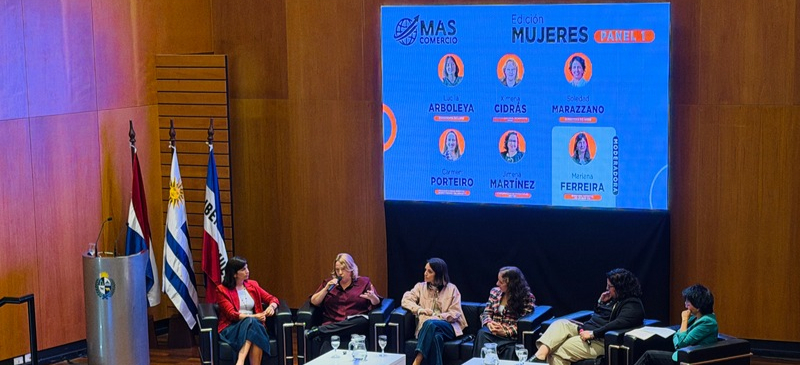
Export readiness, new market opportunities, technical resources, and access to financing were the focus of the first Más Comercio Mujeres event. The gathering brought together more than 150 women, including representatives of business support organizations, business owners, and entrepreneurs in the goods and services sectors.
The initiative is part of Más Comercio, a program that has expanded access to export support across Uruguay since 2022. By the end of 2025, the program had visited each of the country’s 19 departments twice, held 40 workshops with more than 1,000 participants, and provided 130 personalized mentoring sessions. So far in 2026, it has visited Lavalleja, Salto, Paysandú, Colonia, Rivera, and Tacuarembó, with its final event of the year scheduled for November in Soriano.
The Gender Gap in Exporting Companies
In her opening remarks, Uruguay XXI Executive Director Mariana Ferreira explained that, of the 1,045 goods and services exporters for which the agency identified senior management positions, 298 have at least one woman at that level. Women hold just 18.2% of the 2,209 positions analyzed.
“Another notable finding is that when women hold senior management positions, more women also lead other areas of the business. That is a very positive ripple effect that we need to encourage,” she said.
The report also highlights the key role of micro, small, and medium-sized enterprises (MSMEs) in changing this landscape. MSMEs account for 86% of exporting companies with women in leadership roles. Within that group, 82% have women in more than half of their senior management positions.
Ferreira also emphasized the importance of developing evidence-based policy tools. “To design targeted public policy tools, we first need high-quality information. The data point to a twofold challenge: helping more women reach senior management positions in exporting companies and creating the conditions for women-led businesses to grow and expand internationally,” she said.
Support, Competitiveness, and Market Access
The event covered key aspects of entering international markets, including validating a company’s value proposition, tariff classification, simplified shipping procedures, modes of supply for services exports, and identifying international business opportunities.
Claudia Peisino, who leads Más Comercio, highlighted exporting as an opportunity for businesses to learn and develop.
“Selling abroad helps companies grow, innovate, and become more competitive, including in their home market. Companies don’t have to navigate the export process alone. Through Más Comercio and our partner institutions, we guide businesses step by step as they define their niche, develop their cost structure, and make the most of each business opportunity,” Peisino said.
Practical Support and Firsthand Experience
The event featured two panels focused on institutional support and the experiences of women in exporting businesses. Moderated by Mariana Ferreira, “You’re Not Alone: Who Can Help and How” brought together representatives of organizations that support business development. Panelists included Ximena Cidrás, national director of Handicrafts, Small and Medium-Sized Enterprises at MIEM; Soledad Marazzano, director of ANDE; Carmen Porteiro, president of the Union of Exporters of Uruguay; Lucila Arboleya, president of LATU; and Jimena Martínez, operations coordinator at INEFOP. The discussion introduced participants to resources and services available to help their businesses grow.
The second panel, “Exporting Firsthand,” offered a business perspective. It was moderated by Cecilia Casulo, the Uruguayan Chamber of Industries’ representative to the Mercosur Women’s Business Convergence and a director of the Uruguayan Chamber of Manufacturers of Agricultural Machinery and Equipment (CUFMA). Four women shared their experiences in international markets: Cecilia Mato, partner and producer at Navajo Charrúa; Mercedes Vera, co-director of CoveArch; Nara Infantozzi, director of Infantozzi Materiales; and Fabiana Bracco, a member of the management team at Bodega BraccoBosca. Their stories reflected a range of industries and paths into exporting.
Participants also visited participating organizations’ booths to ask questions and learn more about available support. Networking opportunities allowed women business owners to connect with one another and with support organizations.
The event was co-organized with the Municipality of Montevideo; the Organization of Women Business Owners, Executives, and Entrepreneurs of Uruguay (OMEU); the National Institute for Women (Inmujeres); MIEM-Dinapyme; Banco República (BROU); Correo Uruguayo; INEFOP; LATU; the National Development Agency (ANDE); the Union of Exporters of Uruguay (UEU); Women’s Business Convergence; the Technological University of Uruguay (UTEC); the BIOS Institute; the Association of Customs Brokers of Uruguay (ADAU); UNILOG; and DHL.