
- Home
- About us
- News
- Events
- EXPORT Export
- BUY Buy
- INVEST Invest
- COUNTRY BRAND Country Brand
-
INFORMATION CENTER
Information center
InformationCenterInformationCenterReports Country reports Department reports Foreign trade reports Product-Destination worksheet Sectors reports Work documentsStatistical information Classification Uruguay XXI Exports Imports Innovative National Effort Macroeconomic Monitor Tools Buyers Exporters Investors
- Contact
-
Languages
MSMEs account for 83% of the export sector and diversify Uruguay's product offerings
A report by Uruguay XXI analyzes the country's profile, territorial reach, and the challenges of expanding markets
 Publication date: 03/09/2026
Share:
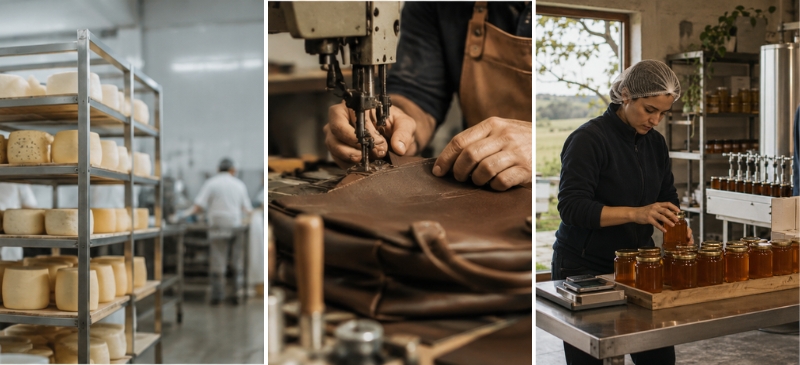
Micro, small, and medium-sized enterprises (MSMEs) represent the vast majority of Uruguay’s export sector, but account for only a limited portion of foreign sales. In 2025, there were 861 such firms, equivalent to 83% of the goods export sector, and they exported US$626 million, or 4.6% of the total value exported by that sector. This contrast occurred during a record year for Uruguayan goods exports, which reached US$ 13,563 million, driven primarily by beef, soybeans, and dairy products—commodities in which the participation of MSMEs is marginal.
The report “Exporting MSMEs 2025,” prepared by the Competitive Intelligence Department of Uruguay XXI, shows that this broad business presence coexists with a more diversified export portfolio and significant differences in scale, market reach, and continuity.
A More Diverse Export Base
One of the distinctive features of MSMEs is the breadth of their export offerings. In 2025, they accounted for 87% of the 730 product lines in which the core export sector recorded sales, and they were the sole exporters in 45% of those lines, with a total value of US$83 million. Large companies, by comparison, were present in 55% of the product lines and were the sole exporters in 13%.
This diversification is also reflected in the breadth of activities. MSMEs were present across nearly the entire export sector and covered more product categories than large companies. In some sectors, they were also the sole exporters. Their share was particularly high in mining, where they accounted for 78% of the export value, and in machinery and equipment, at 71%. In publishing and the creative industries, they represented 97%, while all exports of electrical and electronic equipment and non-metallic construction materials came from MSMEs.
This prominence coexists with a much smaller presence in sectors that account for a large share of the country’s exports. MSMEs accounted for just 3% of sales in agriculture, food, and beverages and 1% in forestry, pulp, and paper.
Diversification also has a territorial dimension. Exporting MSMEs were present in all 19 departments, although Montevideo accounted for 51% of the firms and 46% of the value sold by the segment. In terms of employment, they generated 13,413 jobs, equivalent to 21% of employment in the export sector, with women accounting for 31% of the workforce, compared to 27% among large companies.
Scale, Markets, and Continuity
Significant differences also exist within the MSME sector itself. Medium-sized enterprises accounted for 32% of the segment but accounted for 83% of its export value, with sales totaling US$517 million. At the other end of the spectrum, the 294 microenterprises accounted for just 3%. Meanwhile, half of the MSMEs exported less than US$118,000 in 2025, and the top 100 firms accounted for 66% of the segment’s sales.
This heterogeneity is compounded by a more concentrated international presence. On average, an MSME exported to fewer than three destinations, compared to about 12 for a large company, and more than half sold to a single market. Furthermore, 46% of the export value generated by MSMEs went to South America, compared to 23% for large companies; Mercosur alone accounted for 37% of their foreign sales.
Sustainability emerges as another major challenge. Twenty-seven percent of the companies that were part of the core group of exporters in 2025 had not exported the previous year, and 131 firms made their first export sale. Among microenterprises, more than half had not exported in 2024, and seven out of ten had accumulated five years or less of export activity over the past two decades. The differences become more pronounced when examining long-term trends: while 86% of large firms maintained exports for at least ten consecutive years, among microenterprises that proportion was 10%. Medium-sized firms, on the other hand, exhibit behavior more similar to that of large firms in terms of continuity and variety of export destinations.
The report thus identifies intermittency—rather than a lack of export orientation—as one of the main obstacles to be overcome in order to consolidate the international integration of MSMEs.
Support from Uruguay XXI
The report also analyzes Uruguay XXI’s work with companies in their internationalization processes. In 2025, the agency assisted 662 Uruguayan goods and services companies from 18 departments through consulting, promotional activities, and the identification of export opportunities.
Of the companies assisted, 47.4% had not received support from Uruguay XXI in the previous 24 months. ICT, design, creative industries, and food and beverages together accounted for 75% of the companies assisted, with a strong presence of non-traditional sectors.
The initiative also had a regional component. Through the “More Trade, More Markets, More Investment” program, Uruguay XXI conducted workshops and mentoring sessions in seven inland departments and held a one-day event in Montevideo, in collaboration with other institutions in the ecosystem, to support MSMEs in their internationalization processes.
Ultimately, the analysis highlights a challenge that goes beyond simply bringing new firms into foreign trade: ensuring that more companies can grow, diversify their export markets, and sustain their exports over time. The report identifies MSMEs as key players in moving toward a more diversified, geographically balanced, and resilient export structure.