
- Home
- About us
- News
- Events
- EXPORT Export
-
BUY
Buy
BuyBuyFood and beverage Beef Caviar Dairy Products Fruits Healthy foods Olive oil Processed Foods Rice Sweets, honey and jams Wines ICT Software development Technology products
- INVEST Invest
- COUNTRY BRAND Country Brand
-
INFORMATION CENTER
Information center
InformationCenterInformationCenterReports Country reports Department reports Foreign trade reports Product-Destination worksheet Sectors reports Work documentsStatistical information Classification Uruguay XXI Exports Imports Innovative National Effort Macroeconomic Monitor Tools Buyers Exporters Investors
- Contact
-
Languages
Agro en Punta 2026 Puts Uruguay’s Agribusiness Potential in the International Spotlight
National authorities and regional agribusiness leaders take part in the event, reinforcing Uruguay’s position as a reliable destination for investment
 Publication date: 05/02/2026
Share:
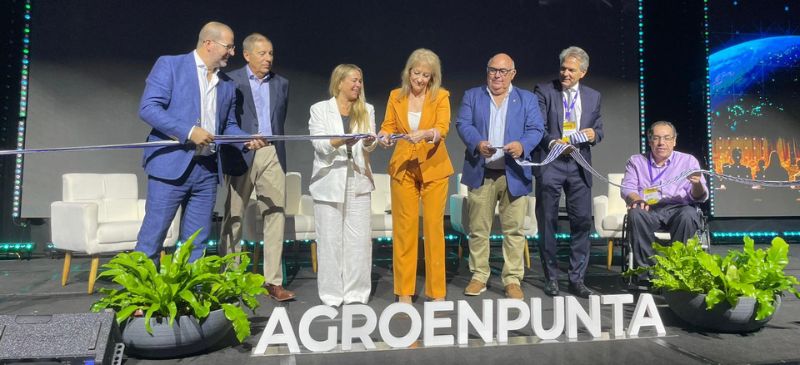
Uruguay is once again presenting itself as a country open to investment, innovation, and long-term business at a new edition of Agro en Punta Expo & Business 2026, taking place until February 6 at the Punta del Este Convention Center. In this strategic setting, Uruguay XXI is supporting the event by promoting the country as a regional hub for agribusiness and innovation.
Organized by Uruguay and the IDB Group, the event brings together leaders from the agro-industrial sector, government authorities, companies, and entrepreneurs, with a strong regional focus and the participation of delegations from Brazil, Paraguay, and Argentina. The program features international forums, more than 50 high-level conferences, a commercial exhibition, and networking spaces aimed at generating concrete business opportunities.
During the opening ceremony, Vice President Carolina Cosse, acting as President, highlighted Uruguay’s competitive edge in agriculture, driven by its early integration of science and technology—an essential factor for competing in demanding markets and attracting high-quality investment.
“The agricultural sector was the first in Uruguay to realize the importance of embracing science and technology, and for many years it has been engaging in dialogue, asking questions, and relying on research,” she said, referring to the work carried out by institutions such as INIA, the University of the Republic, and the Pasteur Institute.
Cosse also emphasized Uruguay’s potential to add value to its production and strengthen cooperation at both regional and international levels. “We have great potential in what has been the development of a scientific base in a stable country, in a country with a healthy democracy, to add value to our products, but also to cooperate and share. And that, in an increasingly tough world, is an important value for Uruguay and for the region,” she said.
In this context, she stressed that environmental sustainability has become a key condition for competitiveness and market access. “We have to take care of our planet because it is the right thing to do, but also because otherwise we will not be able to sell our products in almost any market,” she stated.
For his part, Minister of Economy and Finance Gabriel Oddone stressed that Uruguay’s main asset for attracting investment is the stability it has built over time. “What Uruguay has dedicated itself to building are stable macroeconomic policies, sustained regardless of who is in power. Added to this certainty and predictability are institutional stability and clear rules of the game, which, believe me, make us unique in Latin America,” he said.
Oddone also underlined that Uruguay offers strong conditions for long-term projects. “We are the most stable, most predictable country, with the greatest political stability and the best climate for coexistence, which are essential conditions for the development of long-term business. This is not a country for quick deals or immediate returns. This is a country where long-term business, learning, innovation, and the incorporation of technology and knowledge are key,” he said.
The minister highlighted the importance of international integration and strengthening Uruguay’s commercial and economic ties with the world. He noted that Uruguay’s main trading partner in goods is China, in services it is the United States, and the main source of foreign investment is the European Union, alongside a privileged relationship with Argentina and Brazil.
“We have to be part of all the clubs in the world that respect the rules of the global economy based on cooperation, understanding, and the peaceful resolution of disputes,” he said.
Regarding the agricultural sector, Oddone emphasized its role as a historical driver of competitiveness, innovation, and efficiency in Uruguay’s economy. “The changes that have taken place in the agricultural sector in the last, I would say, 25 or 30 years are very significant. Probably the most significant thing that has happened in the Uruguayan economy,” he said, noting that its strong link to knowledge generation, investment, and technology adoption has strengthened Uruguay’s insertion into deeper international markets.
In this context, Uruguay XXI is implementing an agenda at Agro en Punta focused on attracting investment and supporting the internationalization of companies, providing guidance to potential foreign investors attending the event and supporting companies and startups interested in expanding across the region. As part of this participation, Claudia Peisino, project manager at Uruguay XXI’s Competitive Intelligence Department, spoke on the panel on seeds, where she presented the agency’s support for business internationalization, company assistance, and the promotion of trade agendas aimed at generating new opportunities abroad.
Under the slogan “Key Factor: Agriculture as a driver of economic growth in the region,” Agro en Punta reaffirms its role as a strategic meeting point for regional agribusiness. With Uruguay XXI’s support, the event continues to serve as a platform to showcase why Uruguay offers stability, innovation, talent, and real investment opportunities in high value-added agribusiness.