
- Home
- About us
- News
- Events
- EXPORT Export
-
BUY
Buy
BuyBuyFood and beverage Beef Caviar Dairy Products Fruits Healthy foods Olive oil Processed Foods Rice Sweets, honey and jams Wines ICT Software development Technology products
- INVEST Invest
- COUNTRY BRAND Country Brand
-
INFORMATION CENTER
Information center
InformationCenterInformationCenterReports Country reports Department reports Foreign trade reports Product-Destination worksheet Sectors reports Work documentsStatistical information Classification Uruguay XXI Exports Imports Innovative National Effort Macroeconomic Monitor Tools Buyers Exporters Investors
- Contact
-
Languages
Biotechnology in Uruguay: A Growing Ecosystem Attracting Increasing Investment Interest
A national survey identified 62 active biotechnology companies in the country, highlighting the rise of a knowledge-intensive sector with a strong scientific foundation, a commitment to innovation, and a growing international footprint
 Publication date: 17/03/2026
Share:
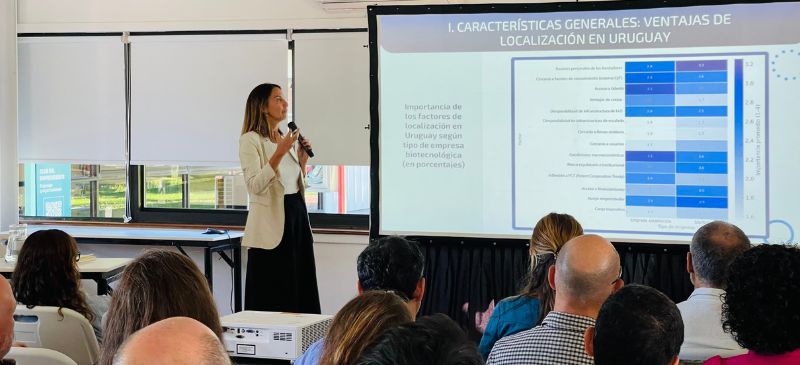
Uruguay is beginning to show—backed by data—that biotechnology is moving beyond its early promise and consolidating into an emerging ecosystem, with established capabilities, innovative companies, and conditions that position it as an increasingly attractive destination for investment.
The study Biotechnology Companies in Uruguay: Productive, Technological, and Economic Characteristics of a Growing Industry, commissioned by Uruguay XXI, the National Agency for Research and Innovation (ANII), and the Inter-American Development Bank (IDB), provides the first systematic mapping of the sector. It identified 62 active biotechnology companies, 62% of which are startups, and conducted an in-depth analysis of 44 firms, representing 71% of the total.
What stands out is not only the number of companies, but how the ecosystem is structured. It is a young, dynamic sector that has expanded rapidly in recent years: between 2014 and 2025, 45 new biotech companies were created, 84% of them startups.
This growth reflects an ecosystem that is generating new science- and technology-based ventures, many of which have emerged from the country’s research system.
This points to one of Uruguay’s key strengths. The report shows that the country is not only home to a concentration of companies, but also to critical capabilities. Montevideo and Canelones account for 85% of firms, in an environment where universities, research centers, scientific infrastructure, and specialized talent converge.
The close link between science and business helps explain both the sector’s growth and its potential to attract medium- and long-term investment.
The analysis also confirms that Uruguay’s biotechnology sector is strongly knowledge-based. It generates 539 jobs, with a highly skilled workforce: 44% of employees hold a university degree and 11% hold a PhD. Among startups, the profile is even more science-intensive: 62% of employees have a university degree and 31% hold a PhD.
The sector’s appeal goes beyond talent availability. There are also clear signs of strong innovation performance. In 2024, 66% of companies’ innovation spending was allocated to R&D, while 70% introduced new products between 2022 and 2024. Notably, 34% developed innovations that were new to the global market.
This innovation-driven profile is also translating into international engagement. The companies surveyed reported total sales of US$34.9 million and exports of US$28.7 million, resulting in a positive biotechnology trade balance of US$6.6 million.
While established companies account for most of these figures, startups provide a key signal for investors: high specialization in biotechnology, a global outlook from an early stage, and strong intellectual property activity.
From an investment promotion perspective, this is a critical point. Cristina Montero, Life Sciences Investment Specialist at Uruguay XXI, emphasized that having an up-to-date profile of the sector “is very important” to better position the country among potential investors. According to her, biotechnology is a “highly capital-intensive” sector, with a constant need for investment to scale from research to development and commercialization, and with “enormous potential for impact” in areas such as healthcare, food production, and sustainability.
The study reinforces this view. Uruguay is emerging as a hub where stability, talent, scientific capabilities, and support for entrepreneurship come together—attributes particularly valued by startups choosing where to locate. This is complemented by an ecosystem that, while still small in scale, already shows strong linkages between companies, academia, public funding, and venture capital.