
- Home
- About us
- News
- Events
- EXPORT Export
-
BUY
Buy
BuyBuyFood and beverage Beef Caviar Dairy Products Fruits Healthy foods Olive oil Processed Foods Rice Sweets, honey and jams Wines ICT Software development Technology products
- INVEST Invest
- COUNTRY BRAND Country Brand
-
INFORMATION CENTER
Information center
InformationCenterInformationCenterReports Country reports Department reports Foreign trade reports Product-Destination worksheet Sectors reports Work documentsStatistical information Classification Uruguay XXI Exports Imports Innovative National Effort Macroeconomic Monitor Tools Buyers Exporters Investors
- Contact
-
Languages
Equity and Leadership: Diversity as a Driver of Competitiveness and Investment Attraction
Mariana Ferreira, Executive Director of Uruguay XXI, participated in the event organized by CUTI and LATU, where she highlighted the role of diversity and ESG criteria as key factors in international positioning and attracting investment
 Publication date: 25/03/2026
Share:
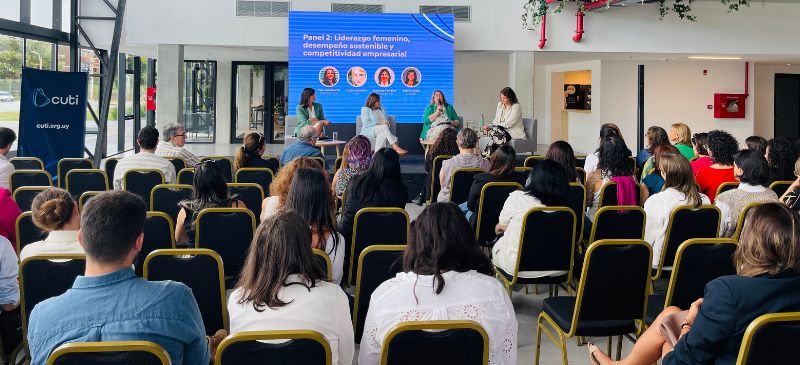
The link between diversity, leadership, and competitiveness was the focus of the event “Equity and Leadership as a Competitive Advantage,” organized by the Uruguayan Chamber of Information Technology (CUTI) with the support of the Uruguayan Technology Laboratory (LATU).
The event brought together representatives from the public and private sectors and international organizations. One of the main panels, “Women’s Leadership, Sustainable Performance, and Business Competitiveness,” was moderated by Inés Jakubovski, CEO of Willin and CUTI Board Member, and featured Lucía Monteiro of ANII, Sylvia Chebi, president of URUCAP, and Mariana Ferreira, executive director of Uruguay XXI.
Meanwhile, the panel “Women in IT: Evidence, Gaps, and Opportunities” included Elizabeth Velázquez (LATU), Carina Di Candia Bocage (LATU), Teresa Pérez (UN Women Latin America and the Caribbean), Fiorella Haim (Ceibal), and Florencia Iglesias Gallo (CUTI). The event also featured the presentation of the report “Women in the IT Industry. Female Leadership 2026”, led by Victoria Cancela.
Diversity, ESG, and Attracting Investment
During her remarks, the executive director of Uruguay XXI, Mariana Ferreira, emphasized that diversity, including gender diversity, has become a key component for competitiveness and attracting investment.
“International investors increasingly value environmental, social, and governance (ESG) criteria, and gender equality is part of these standards,” she noted.
In this regard, she explained that companies that integrate diversity into their decision-making structures not only improve their performance but also strengthen their position with investors and global markets. “Having organizations aligned with these criteria strengthens the country’s reputation and improves its international standing,” she stated.
Ferreira also highlighted women’s participation in foreign trade, where structural challenges persist.
“Only 6.4% of Uruguayan exporting companies are majority-owned by women, and just 13% of general management positions are held by women,” she noted, referring to a study conducted by Uruguay XXI in partnership with CINVE and UN Women.
These data align with the findings of the report presented by CUTI, which shows that, while there is a widespread perception of opportunities for women’s leadership, gaps persist at the highest levels of decision-making and in the implementation of equity policies.
According to the survey of women leaders in the sector, nearly 79% perceive that there are equal opportunities to access leadership positions, although more than half indicate that their companies lack formal gender equity policies.
Furthermore, women account for 33% of employment in the technology sector, and their representation declines at the highest levels of decision-making, reaching 22% in executive positions.
Among the main challenges identified are the work-life balance, the lack of female role models, and the persistence of gender biases, which demonstrates that the gaps are not solely due to individual factors but also to structural conditions within the sector