
- Home
- About us
- News
- Events
- EXPORT Export
-
BUY
Buy
BuyBuyFood and beverage Beef Caviar Dairy Products Fruits Healthy foods Olive oil Processed Foods Rice Sweets, honey and jams Wines ICT Software development Technology products
- INVEST Invest
- COUNTRY BRAND Country Brand
-
INFORMATION CENTER
Information center
InformationCenterInformationCenterReports Country reports Department reports Foreign trade reports Product-Destination worksheet Sectors reports Work documentsStatistical information Classification Uruguay XXI Exports Imports Innovative National Effort Macroeconomic Monitor Tools Buyers Exporters Investors
- Contact
-
Languages
Exporting for growth: gaps and opportunities for female leadership in foreign trade
At the OMEU Women Leaders Forum, experts analyzed the progress and challenges of female leadership. Uruguay XXI presented data, opportunities, and tools to help more women take the leap toward internationalization
 Publication date: 22/12/2025
Share:
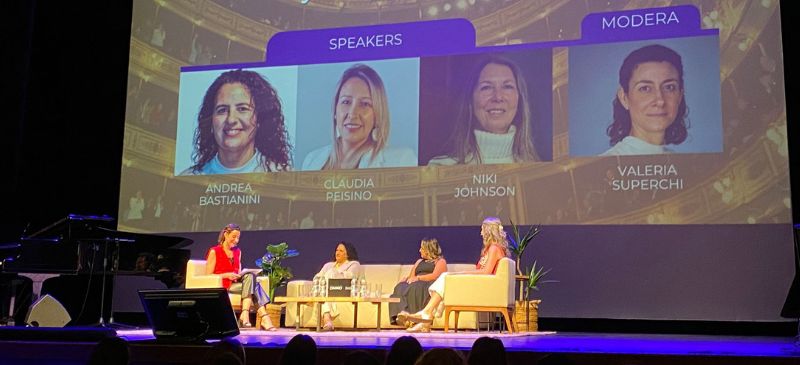
The Women Leaders Forum brought together leaders from the business, academic, and political spheres at the Solís Theater to reflect on female leadership and economic autonomy. The meeting, organized by the Organization of Women Entrepreneurs, Executives, and Entrepreneurs of Uruguay (OMEU), reaffirmed its role as a space for exchange and analysis of persistent gaps, progress made, and paths for change that can foster greater participation by women in decision-making spaces.
The opening remarks were delivered by Florencia Herrera, president of the organization, who welcomed a packed room and highlighted the importance of creating opportunities for dialogue that allow “realities to be made visible and sustainable transformations to be built.” This was followed by the forum’s first panel, titled “Women leaders: gaps, progress, and paths to change”, moderated by journalist Valeria Superchi.
An analysis with data and a call to action
In this context, Claudia Peisino, project manager in Competitive Intelligence at Uruguay XXI and leader of the Más Comercio program, focused her presentation on women’s participation in foreign trade and, in particular, in exporting companies. Her presentation combined analysis, statistical evidence, and a proactive, solutions-oriented approach.
Peisino began by acknowledging that the figures reveal clear inequalities. “If we think about exporting companies, only three out of every ten people who work in them are women,” she said, clarifying that this gap is not due to a lack of preparation. On the contrary, she noted that, according to data from the National Institute of Statistics (INE), women have higher levels of education than men, with a greater share holding tertiary, university, and postgraduate degrees.
The challenge, she explained, lies in access to decision-making positions. A study conducted by Uruguay XXI together with CINVE and UN Women indicates that only 6.4% of companies are majority-owned by women, that just 9% of board seats are held by women, and that women occupy 12.8% of management positions. In the export sector, the situation worsens as companies grow: the larger the firm, the lower the female presence in leadership roles.
“This diagnosis is not meant to discourage us, but rather to help us understand where we stand and what challenges lie ahead,” Peisino emphasized. In this regard, she highlighted recent advances, such as the increase in women’s participation in total employment and the growing number of women entrepreneurs, while warning that a “glass ceiling” persists when it comes to scaling up and consolidating companies with export potential.
Internationalization as a pathway to opportunity
One of the central themes of her presentation was the link between internationalization and closing gender gaps. As she explained, exporting companies led by women tend to hire more women, generating a multiplier effect. She therefore encouraged more women entrepreneurs and business leaders to view exporting as a strategy for growth and for accessing higher-level decision-making roles.
Peisino also addressed the barriers that often hold women back from taking this step, including lack of information, concerns about costs, and the perceived complexity of export processes. “Behind the numbers are women with ideas, quality products, and leadership,” she said, calling on them to overcome their fear of going abroad.
She went on to outline the range of tools Uruguay XXI makes available to support women who decide to pursue internationalization. These include assistance in identifying market niches, analyzing product positioning, and guidance on export requirements, costs, and procedures, all aimed at lowering the barriers that can discourage a first attempt.
Peisino also highlighted the nationwide outreach of the Más Comercio program, which operates across the country to bring these tools closer to women entrepreneurs and business owners from different sectors. “There are women with quality products, a competitive edge, and a strong desire to grow, who just need information and support to get started,” she said, noting that the program seeks to provide that initial momentum and accompany processes that, while challenging, open up new opportunities for growth and leadership.
The panel concluded with two additional presentations that provided broader context and a comprehensive perspective. Andrea Bastianini, representing the Uruguayan Chamber of Commerce and Services, reviewed the evolution of gender approaches in the business sphere, from early initiatives to the incorporation of gender issues into governance, innovation, and internal policy agendas. She also shared recent data on family businesses, showing sustained progress, though resistance remains.
Political scientist Niki Johnson examined female representation in Uruguayan politics, pointing to the slow pace of change and the structural limits that persist in access to positions of power, both in Parliament and within the Executive Branch. Her presentation addressed factors such as the unequal distribution of care work, economic autonomy, and gender-based political violence.
A shared message
Across the panel, the presentations converged on a common conclusion: gender gaps are not the result of a lack of capacity, but of structures and dynamics that require information, policies, and deliberate decisions to change. In this context, Uruguay XXI’s contribution highlighted foreign trade as a concrete lever for the growth of women-led businesses and for advancing greater equity in decision-making spaces.