
- Home
- About us
- News
- Events
- EXPORT Export
-
BUY
Buy
BuyBuyFood and beverage Beef Caviar Dairy Products Fruits Healthy foods Olive oil Processed Foods Rice Sweets, honey and jams Wines ICT Software development Technology products
- INVEST Invest
- COUNTRY BRAND Country Brand
-
INFORMATION CENTER
Information center
InformationCenterInformationCenterReports Country reports Department reports Foreign trade reports Product-Destination worksheet Sectors reports Work documentsStatistical information Classification Uruguay XXI Exports Imports Innovative National Effort Macroeconomic Monitor Tools Buyers Exporters Investors
- Contact
-
Languages
From Pandemic Startup to Buenos Aires Shelves: Dos Orientales’ Export Breakthrough
After joining a Uruguay XXI business round, the Uruguayan company secured its first international deal and is now present in more than 50 supermarkets across Argentina
 Publication date: 07/04/2026
Share:

In 2020, as the world came to a halt and the food industry scrambled to reinvent itself, an idea began to take shape through trial, intuition, and necessity. Five years later, that same initiative has crossed borders: Dos Orientales’ frozen pizzas are now available in more than 50 Jumbo and Disco supermarkets in Buenos Aires, marking the beginning of the company’s international expansion.
The journey was not linear, but it was driven by a clear commitment to creating a differentiated product. “Dos Orientales was born in the middle of the pandemic… we said, ‘let’s make a good pizza that isn’t available around here,’” recalled Mauricio Sánchez, co-founder of the company alongside his siblings Florencia, Francisco, and Guillermo. What started as a response to restaurant closures—combining beer and pizza delivery from their Mala Fama brewery—quickly evolved into a standalone brand with its own identity.
A strong focus on quality, combined with a competitive pricing strategy, became one of the pillars of its growth. “We achieved a very high-quality product at a good price, and that was key,” Sánchez said.
That growth is reflected in its current positioning: Dos Orientales now has more than 200 points of sale in Uruguay, and the supermarket channel accounts for 85% of its pizza sales, consolidating a retail-focused strategy.
With a solid foothold in the domestic market, the company began looking abroad. The opportunity came in 2025, during a business round organized by Uruguay XXI and the Chamber of Industries of Uruguay, which brought together more than 70 Uruguayan companies with buyers from across Latin America and the United States.
The event served as a direct bridge to key regional buyers. It was there that the connection with Cencosud—the retail giant behind Jumbo and Disco—was established. Within months, the agreement became a reality. “I think the meeting was in August, and within six months we already had our pizzas on the shelves,” he explained.
The first shipment to Argentina reached around 6,000 units and marked a turning point in the company’s scale. Today, Dos Orientales exports approximately 8,000 pizzas per month to Argentina, a market that already represents 15% of its total revenue.
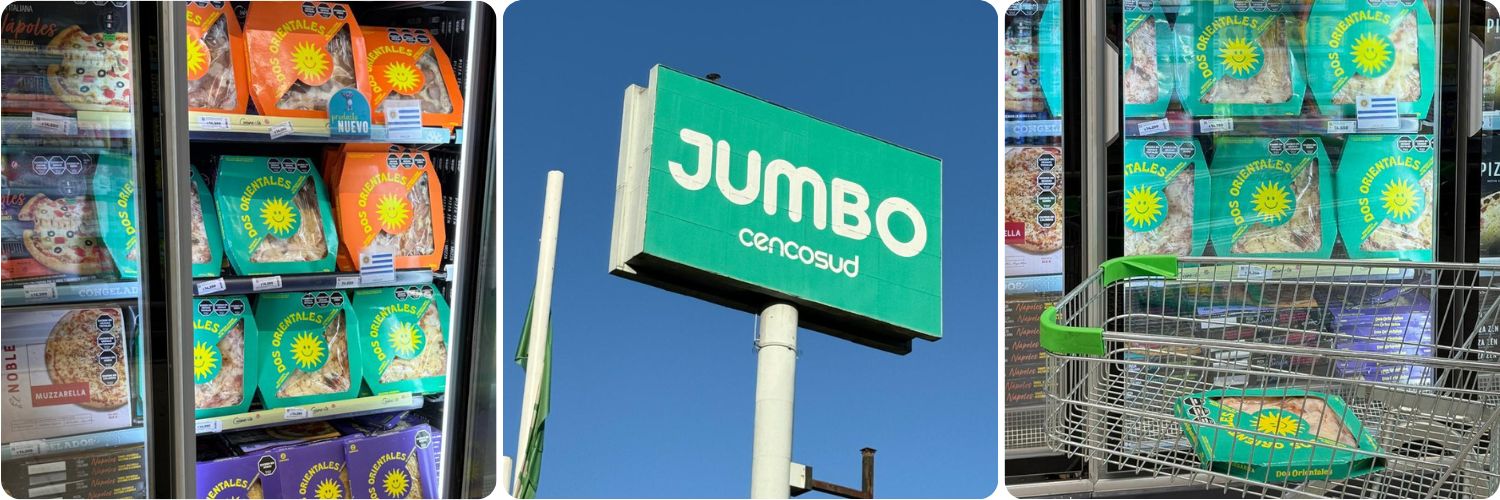
The process involved a series of adjustments and learning experiences, from regulatory requirements to logistics. “You run into new things, like permits—we had to adapt packaging and processes. But exporting isn’t that complicated,” Sánchez said. Far from being a barrier, the experience helped structure the company. “These are large, planned orders that push you to become more organized,” he added.
Exporting has also reshaped the company’s production capacity. Its Montevideo facility currently produces around 45,000 pizzas per month—about 1,100 per day—and operates at full capacity across two shifts to meet both local and international demand.
Growth has also translated into employment. The company now employs 28 people and has expanded its workforce as production increased, adding new shifts including weekends and nighttime operations.
“We had already reached our limit in large retail locally. Expanding abroad is key to sustaining growth,” Sánchez noted. “If you believe in your product and achieve a competitive price, it will naturally stand out.”
Rising demand also led to strategic operational decisions. The company scaled back restaurant operations—now open from Thursday to Sunday—to prioritize production, while maintaining jobs tied to the business. Today, women make up 30% of the workforce, reflecting a growing and increasingly diverse team.
Looking ahead, the company plans to invest in automated machinery from Italy to scale production. The goal is ambitious: to double or even triple output by 2027 and support expansion into new markets.
Argentina—ten times larger than Uruguay—has become a key stepping stone. With positive early results, the company is already exploring opportunities in Brazil and Chile. “This tends to grow in a chain effect,” Sánchez said. With this momentum, Dos Orientales expects to close the year with at least 30% revenue growth.
Beyond this specific case, the experience highlights the role of business rounds as a tool for internationalization. “There’s no more direct way to connect than through Uruguay XXI. These are face-to-face meetings where buyers can try the product—they’re key moments. I don’t know if we would be exporting today if we hadn’t participated,” he said.
For Dos Orientales, that bridge is already in motion. And the image that best captures the journey is both symbolic and tangible: “It makes us proud to see the Uruguayan flag on supermarket shelves in Argentina with a 100% Uruguayan product,” he concluded.
What began in a moment of uncertainty now stands as a clear example of how Uruguayan companies can scale internationally with the right product, strategy, and support.