
- Home
- About us
- News
- Events
- EXPORT Export
-
BUY
Buy
BuyBuyFood and beverage Beef Caviar Dairy Products Fruits Healthy foods Olive oil Processed Foods Rice Sweets, honey and jams Wines ICT Software development Technology products
- INVEST Invest
- COUNTRY BRAND Country Brand
-
INFORMATION CENTER
Information center
InformationCenterInformationCenterReports Country reports Department reports Foreign trade reports Product-Destination worksheet Sectors reports Work documentsStatistical information Classification Uruguay XXI Exports Imports Innovative National Effort Macroeconomic Monitor Tools Buyers Exporters Investors
- Contact
-
Languages
Más Comercio launches a new training program in Lavalleja to boost exports from regional areas.
Uruguay XXI’s workshop in Minas brought together entrepreneurs and SMEs interested in going global, offering practical tools, key insights, and access to mentorship.
 Publication date: 07/04/2026
Share:
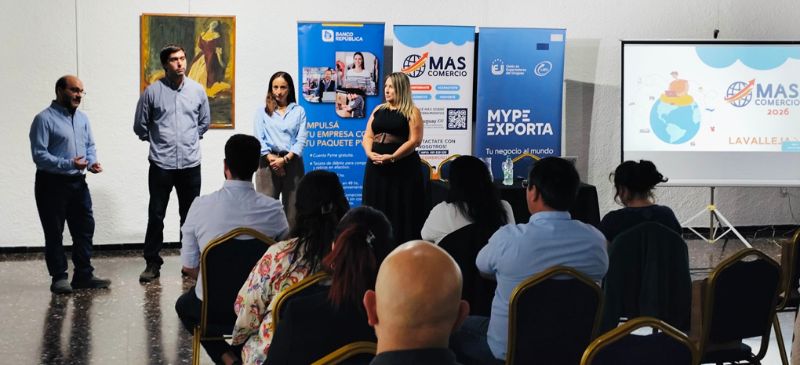
The Más Comercio program, led by Uruguay XXI, kicked off its 2026 edition with a workshop in the department of Lavalleja, marking the beginning of a new nationwide tour aimed at strengthening the export capabilities of entrepreneurs and small and medium-sized enterprises (SMEs) across the country.
The first session took place on Tuesday, March 24, at the Casa de la Cultura in Minas, bringing together companies and entrepreneurs interested in starting their internationalization journey. The free workshop combined practical export tools, information on support programs, and access to personalized mentorship.
Claudia Peisino, Project Manager at Uruguay XXI and leader of the Más Comercio program, highlighted the initiative’s regional focus and its collaborative approach with various institutions. “Más Comercio was created to reach businesses across the country. Together with the ecosystem —Uruguay XXI, SME Centers, INEFOP, LATU, Banco República, MYPE Exporta from the Exporters Union, Dinapyme, and local business chambers— we aim to connect with companies ready to begin their internationalization process,” she said.
She also emphasized that exporting is a real opportunity for companies nationwide. “We want businesses to know that exporting is possible. Exporting companies are more productive, have longer life cycles, and greater capacity for innovation,” she stated, adding that the goal is for participants to leave “with the confidence that they can sell to the world and that there are institutions ready to support them.”
The program focuses particularly on entrepreneurs and companies currently operating in the domestic market but offering differentiated products. “We are not targeting large-scale exports or large corporations. Our focus is on those with quality products, crafted with dedication, that can find niche markets abroad where their uniqueness is valued,” Peisino explained.
Regarding goods, the program aims to leverage the productive base of Uruguay’s interior regions, especially those linked to the agricultural sector. “More than 80% of Uruguay’s exports come from agriculture, and most originate outside the capital. That’s why it’s essential to work locally to identify markets and clients for other types of products,” she noted.
She also highlighted the potential of the services sector beyond Montevideo. “The interior is fully capable of exporting services. Many companies are already doing so. While it involves fewer logistical complexities, it still requires preparation and knowledge of aspects such as costs and tax agreements,” she said. In this context, she pointed to tourism as a well-established example: “Lavalleja is a major exporter of tourism, and tourism itself is a form of service export.”
The Minas workshop is part of a decentralization strategy aimed at bringing knowledge, tools, and support closer to companies throughout the country. Since its launch in 2022, Más Comercio has toured all 19 departments twice, delivering 40 workshops, training over 1,000 participants, and providing around 130 mentorships, with satisfaction rates above 90%.
Following its launch in Lavalleja, the tour will continue in April in Salto and Paysandú, in May in Colonia, in July in Rivera, and in August in Cerro Largo, with additional locations to be confirmed.
“There is an ecosystem, and there are programs and tools designed to support businesses. We approach companies so they can see that exporting is within reach. But preparation is key, and that’s where we come in to support them,” Peisino concluded.