
- Home
- About us
- News
- Events
- EXPORT Export
-
BUY
Buy
BuyBuyFood and beverage Beef Caviar Dairy Products Fruits Healthy foods Olive oil Processed Foods Rice Sweets, honey and jams Wines ICT Software development Technology products
- INVEST Invest
- COUNTRY BRAND Country Brand
-
INFORMATION CENTER
Information center
InformationCenterInformationCenterReports Country reports Department reports Foreign trade reports Product-Destination worksheet Sectors reports Work documentsStatistical information Classification Uruguay XXI Exports Imports Innovative National Effort Macroeconomic Monitor Tools Buyers Exporters Investors
- Contact
-
Languages
Mercosur–European Union: Opportunities and Challenges of the Deal
The agreement, which will enter into force on May 1, was discussed at a workshop organized by the Uruguayan Exporters’ Association, with participation from officials of the Ministries of Foreign Affairs and Economy and Finance, Uruguay XXI, and representatives of the export sector
 Publication date: 06/04/2026
Share:
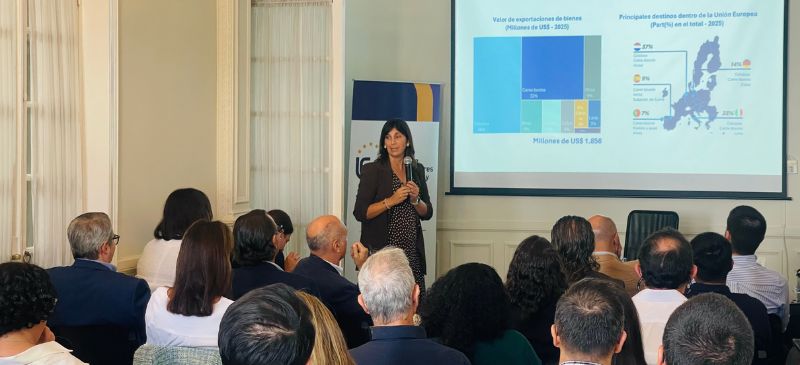
On May 1, the agreement between Mercosur and the European Union will enter into force, marking a milestone that reshapes the bloc’s global positioning. In this context, the Uruguayan Exporters’ Association organized a workshop to address the practical implications of the deal, with the participation of government officials and foreign trade specialists.
Participants included Paola Repetto, Director General for Integration and Mercosur Affairs at the Ministry of Foreign Affairs; Juan Labraga, Director of the Trade Policy Advisory Office at the Ministry of Economy and Finance; Mariana Ferreira, Executive Director of Uruguay XXI; and Matías Camejo, Foreign Trade Coordinator at the Uruguayan Exporters’ Association, who exchanged views and addressed questions from the private sector.
Mariana Ferreira, Executive Director of Uruguay XXI, highlighted the transformative nature of the agreement within the context of a broader expansion of Mercosur’s international integration. “Today, the bloc has access to nearly 4% of global imports. With the negotiations concluded with EFTA, Singapore, and the European Union, that access will rise to around 20%,” she said.
For Uruguay, the Mercosur–EU agreement implies preferential access to markets representing 18% of global imports, effectively quadrupling the country’s current reach. Overall, Uruguay will gain access to economies accounting for 25% of global GDP and 32% of the world’s population.
Ferreira also framed the agreement within a broader trade liberalization strategy pursued by Mercosur, which in recent years has concluded negotiations with blocs such as EFTA and Singapore, and currently has ongoing negotiations with Canada, South Korea, the United Arab Emirates, El Salvador, Lebanon, and Panama, in addition to exploratory talks with Japan, Indonesia, Vietnam, and the Dominican Republic. This process is progressively expanding the bloc’s access to new markets.
The agreement with the European Union reinforces its role as a strategic partner. Over the past two decades, the EU has consistently ranked among Uruguay’s top three export destinations for goods, accounting for approximately 15% of total exports.
Currently, Uruguayan exports to the European Union total nearly US$1.9 billion and are concentrated in products such as pulp, beef, rice, wood, and wool. The main destinations are the Netherlands—which serves as a logistics gateway to the European market—Italy, Germany, and Spain. The export basket remains concentrated in a limited number of products, with a strong emphasis on pulp, beef, and other agro-industrial goods.
However, the agreement’s potential is not limited to major export industries. Ferreira noted that there are niches with a strong orientation toward the European market that could further expand their presence. She also emphasized the importance of integrating micro, small, and medium-sized enterprises: “These are the companies we aim to support in taking advantage of the opportunities created by the agreement,” she said.
Another key area is foreign direct investment (FDI). The European Union currently accounts for approximately 46% of Uruguay’s FDI stock, totaling around US$17 billion. Countries such as Spain, Finland, and the Netherlands lead this flow, with a strong presence in industrial, energy, and global services sectors.
Although the agreement does not include a specific investment chapter, it is expected to act as a catalyst. Comparable experiences in the region show significant increases in FDI following similar agreements, with growth of up to 400% in Costa Rica and nearly 300% in Chile.
In this context, Uruguay XXI has outlined a strategy focused on reducing information gaps and facilitating the effective use of the agreement. Planned actions include the development of a digital platform with clear operational information, the generation of product-specific market intelligence, and support for companies in meeting regulatory requirements, certifications, and traceability standards.
“The challenge is not only to highlight opportunities, but also to support companies in meeting the demands of the European market,” Ferreira emphasized. Efforts will also focus on sectors facing greater challenges, promoting processes of productive transformation and market diversification.
The Mercosur–European Union agreement thus positions itself as a strategic tool for strengthening Uruguay’s international integration, boosting exports, and enhancing its attractiveness as an investment destination.