
- Home
- About us
- News
- Events
- EXPORT Export
-
BUY
Buy
BuyBuyFood and beverage Beef Caviar Dairy Products Fruits Healthy foods Olive oil Processed Foods Rice Sweets, honey and jams Wines ICT Software development Technology products
- INVEST Invest
- COUNTRY BRAND Country Brand
-
INFORMATION CENTER
Information center
InformationCenterInformationCenterReports Country reports Department reports Foreign trade reports Product-Destination worksheet Sectors reports Work documentsStatistical information Classification Uruguay XXI Exports Imports Innovative National Effort Macroeconomic Monitor Tools Buyers Exporters Investors
- Contact
-
Languages
Uruguay Stands Out as a Reliable Investment Destination at the Ibero-American Free Zones Conference
Uruguay’s strong presence in key panels and its active role in the international debate on investment attraction underscored why the country is widely recognized for its stability, talent and high-value business ecosystems.
 Publication date: 03/12/2025
Share:
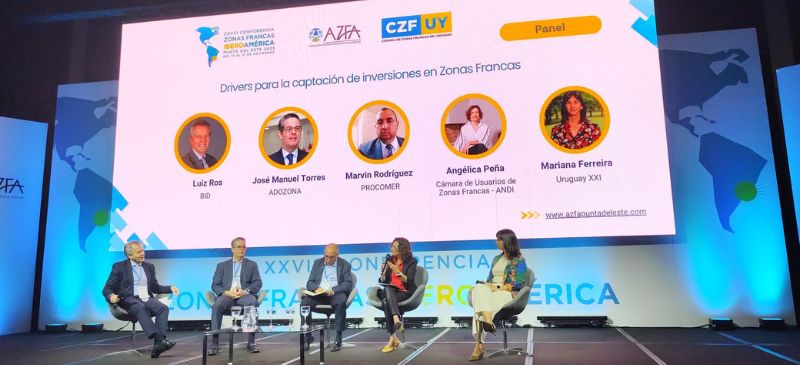
At the XXVIII Ibero-American Free Zones Conference, held at the Punta del Este Convention Center, Uruguay once again demonstrated why its free-zone regime is considered a regional benchmark. Beyond hosting the event, the country contributed technical insights, strategic perspectives and contextual analysis that reaffirm the pillars on which its attractiveness is built: institutional stability, skilled talent, modern infrastructure and a clear regulatory framework aligned with business growth.
On the opening day, Uruguay XXI’s Executive Director, Mariana Ferreira, moderated three breakout sessions focused on e-commerce, supply chains and location factors for investment. The discussions brought together executives from global tech firms, international consultants and logistics leaders who examined the challenges of global trade and the opportunities emerging across the region.
On 20 November, Ferreira also joined the panel “Drivers for Attracting Investment in Free Zones”, alongside representatives from the Dominican Republic, Costa Rica and Colombia, in a session moderated by the IDB’s Representative in Uruguay, Luiz Ros.
A Regional Outlook: Uruguay as a Point of Reference
During the e-commerce panel, Diego Gamba of Mercado Libre highlighted the country’s strategic importance within the company’s regional operations. “For us, Uruguay is a fundamental hub. We have more than 1,800 people working here, and I’d say over 800 are dedicated to technology, product development and innovation,” he noted.
Meanwhile, Pedro Saravia (TiendaMia) and Diego Szilagyi (nocnoc) agreed that Uruguay’s blend of infrastructure, talent and predictability gives the country a competitive advantage in the expansion of e-commerce, particularly cross-border trade.
In the supply-chain session, Alejandro Torrendell (Merck) drew on three decades of the company’s operational experience in Uruguay. “If it weren’t for the free-zone regime, we wouldn’t be here,” he said.
For his part, Kadir Issa (McKinsey) pointed to a global landscape defined by ongoing disruptions and rising demand for destinations that offer both predictability and adaptability.
Finally, in the discussion on location factors, Pilar V. Cerón (Xtrategy US LLC) outlined how free zones have evolved into integrated environments that reduce friction for investors, while Sebastián Moreno (IDS) summarized the logic shaping today’s investment decisions. “Investment is about risk. If there’s uncertainty, what I look for is a way to minimize that risk,” he emphasized.
Together, the three panels highlighted that, in an increasingly volatile international context, Uruguay stands out as a country capable of offering clear rules, available talent and ecosystems that enable sustained growth.
International Panel: Stability as Uruguay’s Differentiating Strength
On the second day of the conference, Mariana Ferreira participated in the international panel on investment drivers in free zones, joining experts from the Dominican Republic, Costa Rica and Colombia to examine the factors influencing capital flows into the region. Moderated by Luiz Ros of the IDB, the conversation positioned Uruguay’s experience within the broader global discussion on risk, talent and certainty.
Ferreira opened her remarks with a data point that illustrates the weight of the regime in Uruguay’s economy: “Today, 40% of Uruguay’s goods exports originate in free zones, and more than 60% of non-traditional services exports as well.”
She stressed that the free-zone regime has remained a long-standing state policy—an aspect that helps explain Uruguay’s success in attracting investment seeking long-term stability and predictability.
Ferreira also described how Uruguay presents its regime during international investment-promotion missions. “When we go abroad, we showcase the free zones in Uruguay,” she said, noting that external perceptions often change once companies experience the ecosystem firsthand.
She highlighted the diversity of industrial, mixed and services-oriented parks that operate under a stable regulatory framework, offering conditions conducive to establishing, scaling and diversifying operations. Uruguay XXI’s promotional efforts consistently emphasize the country’s combination of clear incentives, high-quality infrastructure and an environment that has attracted major investments in pulp, pharmaceuticals, technology, logistics and global services.
International panelists also pointed to Uruguay’s performance. Angélica Peña (ANDI, Colombia) stressed the country’s political continuity, recalling “an extraordinary photo of several Uruguayan presidents together inaugurating a free-zone project”—a symbol, she said, of a rare political consensus in the region.
From Costa Rica, Marvin Rodríguez (PROCOMER) highlighted the similarities between both countries’ models, especially in talent, stability and business climate—areas where Uruguay and Costa Rica consistently lead in Latin America.
Across the panel, there was consensus that in a volatile global environment, countries capable of maintaining clear rules and skilled human capital gain a significant competitive edge.
Ferreira concluded by returning to the central theme of the session. “Free zones have been crucial for Uruguay to attract certain types of investment,” she stated. The discussion left a shared impression: in an international context marked by uncertainty, Uruguay consolidates its reputation as a reliable environment in which to invest, operate and plan for the long term.
FEATURED NEWS:
- Uruguay Reaffirms Regional Leadership at the 28th Ibero-American Free Trade Zone Conference
- Uruguay will welcome global leaders in November to the 28th Ibero-American Free Trade Zone Conference
- Uruguay XXI participated in the IBA’s international conference on mergers and acquisitions in Latin America