
- Home
- About us
- News
- Events
- EXPORT Export
-
BUY
Buy
BuyBuyFood and beverage Beef Caviar Dairy Products Fruits Healthy foods Olive oil Processed Foods Rice Sweets, honey and jams Wines ICT Software development Technology products
- INVEST Invest
- COUNTRY BRAND Country Brand
-
INFORMATION CENTER
Information center
InformationCenterInformationCenterReports Country reports Department reports Foreign trade reports Product-Destination worksheet Sectors reports Work documentsStatistical information Classification Uruguay XXI Exports Imports Innovative National Effort Macroeconomic Monitor Tools Buyers Exporters Investors
- Contact
-
Languages
Publishers from Mexico, Spain, and Brazil visit Montevideo and open new business opportunities for Uruguayan books
Uruguay XXI hosted publishers Santiago Tobón and Sandro Aloisio for business meetings, a literary tour, and a public talk at the International Book Fair
 Publication date: 22/01/2026
Share:
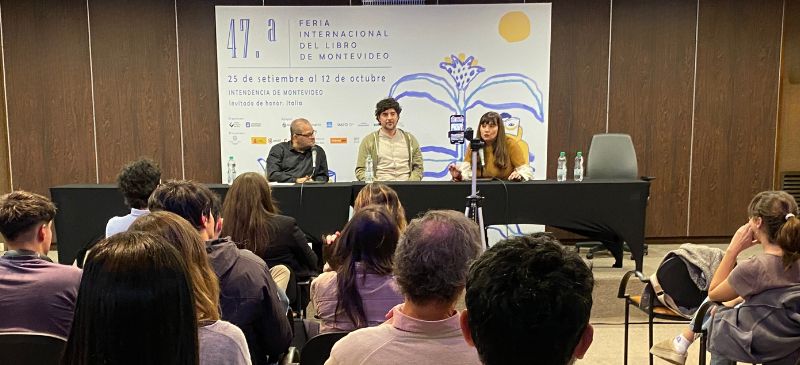
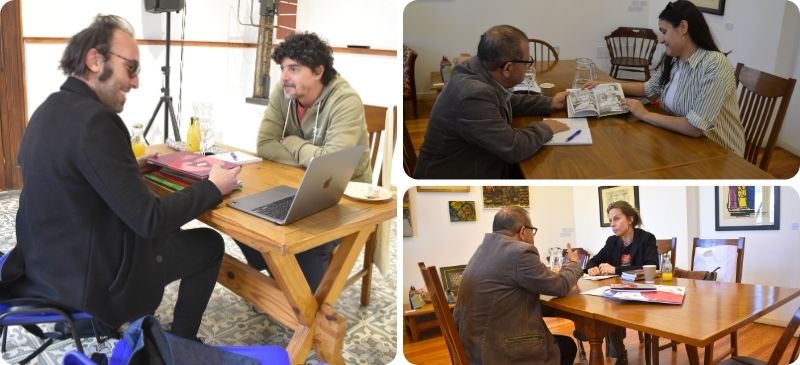
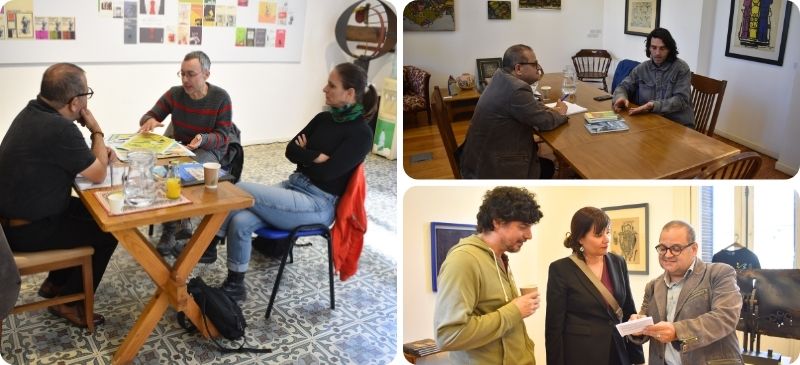
For two days, the Mario Benedetti Foundation became a meeting ground for the Uruguayan book world: folders, mock-ups, and portfolios spread across the tables; publishers listening, asking questions, taking notes; authors and illustrators pitching their projects with a balanced mix of nerves and conviction. The business roundtable organized by Uruguay XXI brought together local publishers and creators with two key international guests: Santiago Tobón, co-director of Sexto Piso (Mexico and Spain), and Sandro Aloisio, editorial director at Grupo Escala (Brazil).
Alongside the meetings, the visitors joined a heritage tour of Montevideo’s literary landmarks and took part in a conversation at the 47th International Book Fair. The experience produced concrete leads, shared learning, and a clear takeaway: internationalizing Uruguay’s publishing output is both possible and essential.
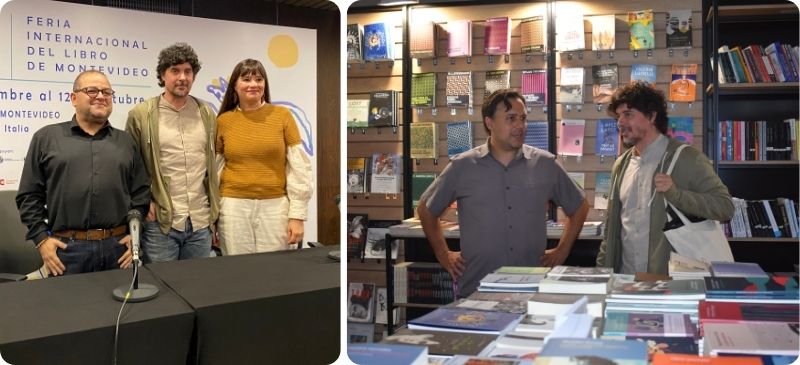
“For the first time, we are carrying out this type of reverse mission—bringing key international players to Montevideo so they can understand the sector and also the cultural character of our country,” said Omaira Rodríguez, Creative Industries Promotion Specialist at Uruguay XXI, as she opened the talk in the Book Fair.
Regional bridges and new opportunities
Brazilian editor Sandro Aloisio spoke with simplicity and conviction. “I was struck by the diversity and strength of Uruguayan illustration. I want to believe I will close some collaborations to introduce these artists in Brazil—both with projects presented to me here and with Brazilian authors illustrated by Uruguayan artists,” he said.
He also offered a candid regional reflection: “There is a cultural debt among our countries. We look too often to Europe and the United States. We need to strengthen ties within South America.”
Santiago Tobón outlined Sexto Piso’s publishing vision—six collections, around 600 titles, and a broad literary project aimed at the entire Spanish-speaking world—and highlighted Uruguay’s creative vitality. “The editorial effervescence in Uruguay is uncommon. In illustration, I saw depth and singular styles. I’m taking home a lot to read: there is literary value to share with our readers,” he said.
Catalogues on the move
On the local side, Julia Ortiz of Criatura Editora appreciated how well prepared the visitors were. “They arrived already informed about our catalogue, with clearly defined interests. That can lead to productive exchanges,” she said. She also pointed to the challenges faced by small and mid-sized publishers: “We can’t always travel or have someone dedicated exclusively to selling rights. Having potential partners come to Montevideo is decisive.”
From Fin de Siglo, Estefanía Canalda shared this view. “Sexto Piso is perhaps the most important catalogue in Spanish. The dialogue was genuine—about literature. For a small market like Uruguay, internationalization must be a central cultural policy goal,” she said.
The illustrators’ perspective
Illustrator Ana Bidault, who works with an international agency, emphasized the value of in-person encounters. “I rarely get the chance to speak directly with publishers or agents. Traveling to fairs is difficult. Having them come here and being able to sit down and talk is invaluable,” she said. Her meeting with Aloisio left her hopeful: “He was interested in my graphic novel’s narrative and in a style he may not yet have in his catalogue.”
From Maldonado, illustrator Natalia Risso arrived nervous but prepared. “It was my first formal meeting with a publishing representative, and I’m leaving with a positive feeling. Whether something comes of it or not, just presenting yourself, trying, and breaking through your fears is already a victory,” she reflected. Public support, she added, is crucial: “It’s an essential bridge; without it, many of us would remain isolated.”
Illustrator Dani Scharf highlighted the relevance of the visitors’ profiles. “I studied their catalogues and brought pieces that could fit, but also others that were different, to open new possibilities. The feedback was great; I hope projects materialize,” he said. “These opportunities are welcome and necessary. We often have to travel to find them—having them come to us changes the game.”
For Sebastián Santana, accustomed to international fairs, the greatest value lay in professional critique: “It’s challenging to see how someone who reviews thousands of books reads your work. Even a critical response helps you grow. In my case, he really liked it and invited me to continue in touch.”
Illustrator and journalist Paz Sartori focused on international adaptation. “We showed collections conceived for our market and discussed how to bring them to others. An email or Zoom call isn’t the same as having the book in hand and exploring common ground. I left thinking about illustrating with internationalization in mind from the start.”
Illustrator Federico Taibo left with a surprise: “Sandro wants to present one of my projects to a colleague in Brazil. It was something I had almost forgotten and brought just to show another style. He was drawn to the drawing, color, and versatility—and to the fact that I’m the sole author.”
‘Gigante’ and the voice of young readers
The team behind Gigante, the monthly newspaper for children and teenagers published by la diaria, attended with its editorial director Martín Otheguy and strategic alliances manager Lucía Pardo. They presented a publication built around themes and with active participation from its young readers. “We have an advisory group of children who help decide the content. Sandro arrived knowing exactly what we do and which sections interested him. We left very pleased,” said Otheguy.
For them, the arrival of international peers is a real connector: “Sometimes it feels like you’re shouting into the void; receiving appreciation and questions from someone abroad gives you hope.”
New voices, wider horizons
Writer Margarita García Telesca presented Relatos diversos, short stories inspired by LGBTQ+ experiences from Uruguay’s interior. “The reception was very thoughtful. We are a small market, and connecting with the outside world is vital,” she said. She also recalled another opportunity created through Uruguay XXI, which took her to Madrid for Rodando Páginas with her book Un virus de amor. “That sparked the process for a film adaptation with a Spanish-Argentine production company. The first step is always the key one,” she noted.
Support that strengthens the industry
Across testimonies, one point was unanimous: initiatives like these are essential. For many publishers, they provide necessary backing in the face of limited scale and resources.
“It’s the only viable way for local publishers given our size and business capacity,” said Julia Ortiz.
Internationally experienced illustrator Sebastián Santana highlighted its strategic importance: “Strong editorial ecosystems require state participation—not just for economic reasons, but for the symbolic and cultural projection of a country.”
From a territorial perspective, Natalia Risso reiterated: “It’s a crucial bridge; without it, many of us would remain blocked off.”
The Gigante team expressed a similar message: “This is unlikely to happen through the private sector alone. The fact that a public agency drives it shows it’s a matter of collective interest.”
Illustrators echoed this view. “These opportunities make visible a kind of work that often feels invisible in Uruguay,” said Ana Bidault. Scharf and Taibo added that bringing international professionals to Montevideo enables connections that would otherwise be impossible due to travel costs and lack of access to networks.
Together, the mission confirmed that Uruguay XXI’s strategy is widely seen as an indispensable driver for projecting the Uruguayan publishing industry beyond its borders and opening growth pathways for authors, illustrators, and publishers.
Heritage as a policy for the future
The mission extended beyond business meetings. Guided visits to the Torre de los Panoramas of Julio Herrera y Reissig, the Casa de Susana Soca, and the Zorrilla Museum provided cultural context. “It was a powerful immersion,” Aloisio said. “I was moved by how you preserve your memory. That, too, is something you export.”
For Tobón, the roadmap was clear: “I’m taking home homework—reading, mapping, and circulating Uruguayan voices throughout the Spanish-speaking world.”
As the discussion at the Fair concluded, Omaira Rodríguez announced the next step: editor Carolina Orloff (Charco Press) will visit Montevideo from November 10 to 14 to continue the round of meetings.
Uruguay XXI’s reverse mission offered a complete picture: competitive talent, diverse catalogues, powerful illustration, and a creative ecosystem that grows stronger when it opens its doors. The visiting publishers leave with projects in hand—and a message to their peers: look further south, and closer.