
- Home
- About us
- News
- Events
- EXPORT Export
-
BUY
Buy
BuyBuyFood and beverage Beef Caviar Dairy Products Fruits Healthy foods Olive oil Processed Foods Rice Sweets, honey and jams Wines ICT Software development Technology products
- INVEST Invest
- COUNTRY BRAND Country Brand
-
INFORMATION CENTER
Information center
InformationCenterInformationCenterReports Country reports Department reports Foreign trade reports Product-Destination worksheet Sectors reports Work documentsStatistical information Classification Uruguay XXI Exports Imports Innovative National Effort Macroeconomic Monitor Tools Buyers Exporters Investors
- Contact
-
Languages
Uruguay advances a national strategy to promote its culture on the global stage
The Cultural Internationalization Committee, which includes Uruguay XXI and other public institutions, held its first public working session
 Publication date: 13/02/2026
Share:
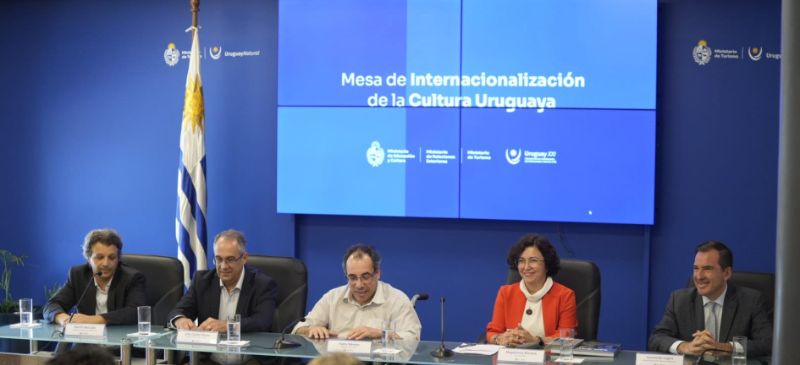
Uruguay has taken a new step toward developing a sustained national policy for cultural internationalization through a high-level dialogue with Magdalena Moreno, Executive Director of the International Federation of Arts Councils and Culture Agencies (IFACCA). The event, held on February 10 at the Ministry of Tourism, marked the first public working session of the Committee for the Internationalization of Culture.
The committee brings together the Ministry of Education and Culture, through the National Directorate of Culture; the Directorate General for Cultural Affairs of the Ministry of Foreign Affairs; the Ministry of Tourism; and Uruguay XXI. This interagency initiative aims to strengthen the international presence of Uruguay’s cultural talent and creative industries through coordinated public policy efforts.
Martín Mercado, Deputy Director of Uruguay XXI, participated in the roundtable and highlighted the need to deepen understanding of culture’s contribution to the national economy. He also stressed the importance of reinforcing inter-institutional coordination in order to advance a long-term national strategy. His remarks formed part of a broader exchange on the creative economy, cultural diplomacy, and the development of a national narrative capable of engaging international audiences.
In his opening remarks, Minister of Education and Culture José Carlos Mahía stated that “the internationalization of culture, when properly organized, is a structural component of the design of our public policies on culture, tourism, and development in general.” He also emphasized that cultural and creative economies “generate employment, innovation, and sustainable development, but also strengthen the country’s image.”
Along the same lines, Minister of Tourism Pablo Menoni highlighted that “transversality goes hand in hand with the synergy among the institutions supporting this process.” He described cultural tourism as “a strategic segment and a showcase for promoting Uruguay abroad,” reaffirming his ministry’s commitment to this agenda.
From the Ministry of Foreign Affairs, Director General for Cultural Affairs Fernando Lugris noted that the event took place “at a particularly opportune moment, as the country is making strategic decisions about the international projection of its culture.” He also stressed that internationalization is a central public policy priority.
During her presentation, Magdalena Moreno underscored that cultural internationalization cannot be approached solely through an economic lens. Instead, she argued, it must incorporate cultural rights, identity diversity, artistic mobility, cultural diplomacy, digital platforms, and coordinated public policies. In a global context shaped by the climate crisis, rapid digital transformation, and persistent inequality, she warned of the risks of cultural homogenization and stated: “Before projecting ourselves internationally, we must ask ourselves who we are and how we want to represent ourselves.”
In this context, the dialogue also highlighted Uruguay XXI’s ongoing work to support the internationalization of cultural and creative industries, in line with its mandate to promote exports and strengthen Uruguay’s country brand. Over the past decade, the agency has helped open international markets for sectors such as publishing and illustration, music, audiovisual production, advertising, video games, and fashion. This has been achieved through trade missions, the attraction of key international stakeholders to Uruguay, the promotion of participation in strategic fairs and events, training and advisory support for Uruguayan exporters and emerging exporters, and international positioning initiatives that help showcase national talent abroad.
The meeting also brought together authorities and technical teams from a range of public institutions linked to the sector, further strengthening a strategic dialogue space aimed at defining a clear roadmap, supported by political commitment and long-term institutional continuity. The objective is to integrate culture as a structural dimension of national development and enhance Uruguay’s cultural presence on the global stage.