
- Home
- About us
- News
- Events
- EXPORT Export
- BUY Buy
- INVEST Invest
- COUNTRY BRAND Country Brand
-
INFORMATION CENTER
Information center
InformationCenterInformationCenterReports Country reports Department reports Foreign trade reports Product-Destination worksheet Sectors reports Work documentsStatistical information Classification Uruguay XXI Exports Imports Innovative National Effort Macroeconomic Monitor Tools Buyers Exporters Investors
- Contact
-
Languages
Audiovisual: “On the international scene, the distribution strategy is just as important as the work itself”
French programmer Jean-Christophe Berjon discussed the challenges facing Latin American cinema at international film festivals and highlighted the distinct identity of Uruguayan cinema as its greatest strength
 Publication date: 21/04/2026
Share:
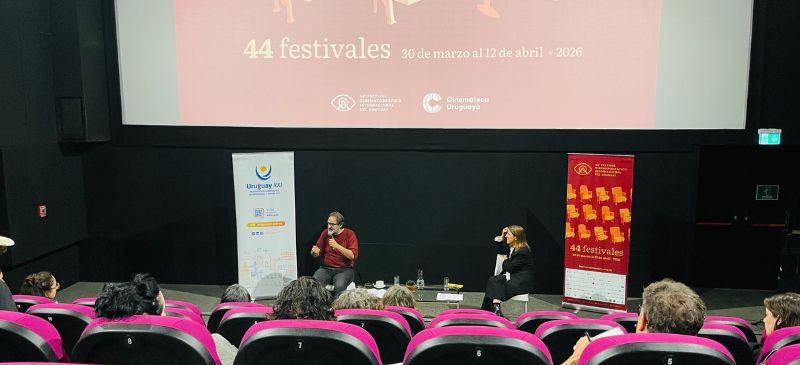
As part of the 44th Uruguay International Film Festival, Uruguay XXI and the Uruguayan Film Archive invited French programmer Jean-Christophe Berjon to discuss the challenges facing Latin American cinema in the European market. His visit is part of an ongoing strategy to highlight the importance of executive production in the development of the national film industry.
The presence of Latin American cinema at major international festivals, its opportunities and limitations, as well as the keys to positioning films in an increasingly competitive landscape, were the focal points of the conference given by Jean-Christophe Berjon in Montevideo. The specialist—general delegate of the Biarritz Amérique Latine Festival and with an extensive career at Cannes and Morelia—shared his experience with local filmmakers and producers during an exchange event organized by Uruguay XXI and the Uruguayan Cinematheque.
In conversation with Uruguay XXI, Berjon referred specifically to Uruguayan cinema, which he identified as a film industry with its own distinct characteristics that are valued internationally. “It reflects a certain philosophy of life among the Uruguayan people. I see a generosity, an emotional complexity, yet one that is serene and open,” he stated.
In his view, films such as Whisky, El baño del Papa, and Mal día para pescar have established a recognizable image. “It is something profound, sincere, yet deeply humanistic,” he said. That identity, he argued, constitutes a competitive advantage. “Uruguayan cinema isn’t always prominently featured in the major circuits, but it is respected. It’s a unique alternative and is highly valued,” he added.
Along those lines, he considered that the main challenge is to sustain and deepen that uniqueness. “The future of Uruguayan cinema lies in continuing to cultivate its profound identity,” he remarked.
Keys to Understanding the International Festival Circuit
Beyond identity, the challenge also lies in understanding how the festival system works on a global level. In this context, during the event, Berjon emphasized that a film’s journey through festivals depends on multiple factors that go beyond its artistic quality. “There’s what you see, and there’s everything that happens behind the scenes: balances, curatorial decisions, relationships with the audience, and the context of each country,” he explained. In that sense, he insisted on the need to understand the audiovisual ecosystem as a complex network, where the distribution strategy is just as important as the work itself.
One of the central points was the role of executive production and planning prior to submitting to festivals. “Before talking about strategies, you have to understand what the film is and what you expect from it,” he noted. For the specialist, not all productions pursue the same objectives; some seek visibility, others aim to recoup investment or build networks for future projects. “You rarely get everything in one go,” he cautioned.
The specialist also addressed the growing number of productions seeking to enter international festivals. As he explained, the increase in supply—driven by technological and contextual changes—is generating increasingly intense competition. “Today there are many more films than before trying to enter the same spaces,” he noted.
In this scenario, the global context plays a decisive role. “It’s not just the quality of the film; it’s the timing, the country, the trends. There are years when certain film industries have more visibility than others,” he explained.
He also highlighted the importance of festivals as platforms for connection beyond mere exhibition. “They’re a travel agency for films, but also a space to foster encounters, connections, and future opportunities,” he noted.
Strategy and Distribution
Berjon recommended that executive producers approach the distribution of their works in a comprehensive and flexible manner, considering both major festivals and alternative circuits. “It’s not a failure to start at smaller-scale festivals. On the contrary, it can be a great achievement and a gateway,” he said.
He also emphasized the importance of understanding release rules—worldwide, international, continental—and planning accordingly. “Accepting one festival often means turning down others. That’s why you have to carefully evaluate every decision,” he explained.
Regarding the relationship with sales agents, he was clear. “A good agent doesn’t charge for promoting the film; they invest in it. Their interest is in getting it distributed and sold,” he assured. However, he acknowledged that not all productions manage to secure this type of support, which forces filmmakers themselves to take on the distribution strategy.
A Long-Term Strategy
Berjon’s visit joins other initiatives promoted by Uruguay XXI to strengthen the internationalization of the audiovisual sector. Last year, at this same event, Berlinale programmer Ana David participated, while sales and distribution agents attended the Nuevo Detour Film Festival.
These actions aim to consolidate ties with local executive producers and disseminate information that helps position Uruguayan cinema on the international stage.
Against the backdrop of an industry in transformation, with the emergence of streaming platforms and new consumption models, the specialist emphasized that recognition at festivals remains a key asset. “The festival puts a stamp on it: it says ‘this film is worth watching.’ That remains very important,” he stated.
However, he also warned of the system’s limitations. “Artistic recognition does not always translate into economic results. It is a constant tension between creation and the market,” he concluded.
Berjon’s participation provided a roadmap for local professionals to understand the ecosystem, design strategies, and, above all, commit to their own identity as their main point of differentiation.