
- Home
- About us
- News
- Events
- EXPORT Export
- BUY Buy
- INVEST Invest
- COUNTRY BRAND Country Brand
-
INFORMATION CENTER
Information center
InformationCenterInformationCenterReports Country reports Department reports Foreign trade reports Product-Destination worksheet Sectors reports Work documentsStatistical information Classification Uruguay XXI Exports Imports Innovative National Effort Macroeconomic Monitor Tools Buyers Exporters Investors
- Contact
-
Languages
Roche reaffirms Uruguay as a global hub for the export of pharmaceutical services
International executives from the company visited the country and confirmed Montevideo's status as one of its strategic hubs
 Publication date: 28/05/2026
Share:
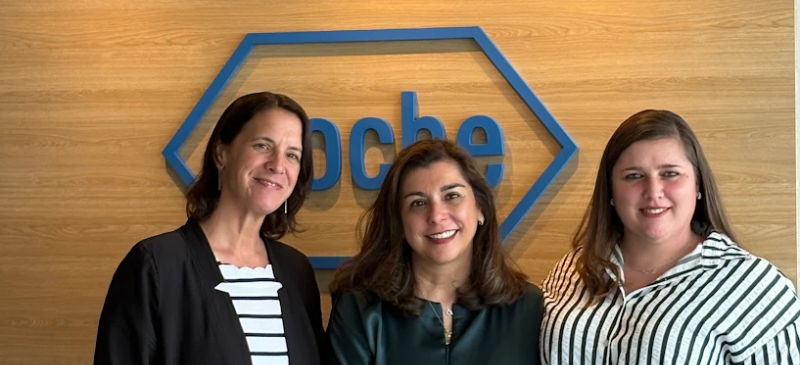
Montevideo welcomed some of Roche’s top global executives in the Pharma Technical Regulatory (PTR) division, signaling Uruguay’s growing prominence within the pharmaceutical company’s international operations. The arrival of Nicole del Canto, PTR IO Head, and Negar Sadrzadeh, PTR Centralization & Compliance Head, alongside the global leader of the division in Uruguay, Erika Hannibal, reinforced the country’s recognition as a strategic hub for the export of specialized, high-value-added services.
From Montevideo, Roche coordinates regulatory and technical processes related to the registration and maintenance of innovative medicines for more than 120 markets. The Pharma Technical Regulatory (PTR) - International Operations (IO) team, led by Erika Hannibal, works in close coordination with global centers located in Basel, Singapore, and Mississauga, playing a key role in the global supply chain for access to pharmaceutical treatments.
The Uruguayan center began operations on April 22, 2014, as a pilot project with just two people. In just over a decade, it has evolved into a center of excellence that centralizes critical functions for highly demanding markets such as Europe, the United States, and China.
As Hannibal explained, Roche’s decision to expand and centralize operations in Uruguay was driven by a combination of strategic factors. “The choice of Uruguay to host one of our four global centers stems from its legal stability and, fundamentally, the extremely high educational level of its professionals. Here we find the talent needed to manage processes of extreme technical complexity,” she stated.
The executive also highlighted that the country has positioned itself as a competitive environment for the development of knowledge-intensive global services, thanks to its institutional stability, a solid legal framework, and a favorable geographic location for international coordination.
The PTR division acts as a technical bridge between the manufacturing of complex medicines—including biologics and small molecules—and the health authorities of each country. Among its main functions are the preparation of regulatory dossiers, ensuring international regulatory compliance, and managing renewals and post-approval changes to guarantee the continuity of drug supply.
“Today we handle registration submissions and renewals for all Roche products worldwide,” noted Hannibal, who also highlighted the development of local capabilities in digitization and artificial intelligence processes applied to the regulatory area.
Although Uruguayan university education is largely focused on national regulations, Roche has developed internal training and onboarding programs that enable the transformation of local talent into specialists with a global reach.
For Nicole del Canto, the international work model implemented from Uruguay represents an opportunity for professional growth and knowledge generation. For her part, Negar Sadrzadeh highlighted the Uruguayan team’s ability to drive new ways of working within the organization. As she noted, local talent is setting a global precedent in the adoption of a digital mindset aimed at increasing efficiency and simplifying complex regulatory processes.
With this evolution, Roche reaffirms Uruguay’s role as a regional and global platform for the export of specialized corporate services, backed by qualified talent and growing capabilities in innovation and digital transformation.