
- Home
- About us
- News
- Events
- EXPORT Export
- BUY Buy
- INVEST Invest
- COUNTRY BRAND Country Brand
-
INFORMATION CENTER
Information center
InformationCenterInformationCenterReports Country reports Department reports Foreign trade reports Product-Destination worksheet Sectors reports Work documentsStatistical information Classification Uruguay XXI Exports Imports Innovative National Effort Macroeconomic Monitor Tools Buyers Exporters Investors
- Contact
-
Languages
Spanish business leaders and officials highlighted Uruguay's stability, talent, and regional influence
Minister Fernanda Cardona and Uruguay XXI led a meeting in Madrid to promote investment and business with Spain
 Publication date: 03/06/2026
Share:
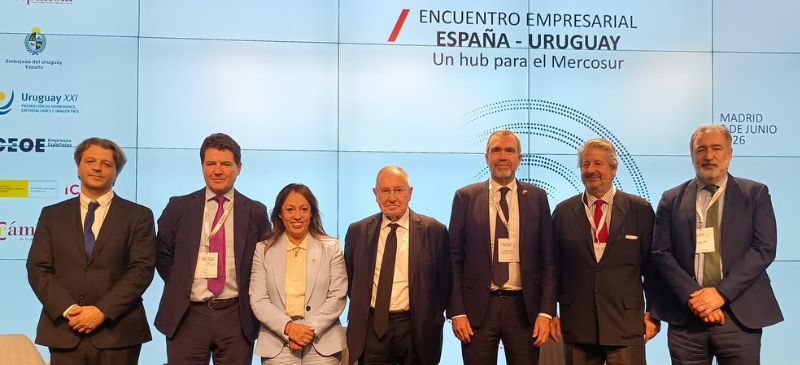
Madrid hosted the Spain–Uruguay Business Forum: A Hub for Mercosur on Tuesday, an event that brought together officials, business leaders, and investors from both countries to discuss opportunities for trade, investment, and innovation, against the backdrop of the entry into force of the trade agreement between the European Union and Mercosur. The event, attended by Industry Minister Fernanda Cardona, was organized by Uruguay XXI, the Spanish Chamber of Commerce, and the Official Spanish Chamber of Commerce in Uruguay, with support from ICEX, CEOE, and the Uruguayan Embassy in Spain.
During the opening remarks, Cardona emphasized that Uruguay offers “certainty” to those seeking to invest and develop businesses in the region. The minister highlighted the country’s institutional stability, legal certainty, macroeconomic discipline, renewable energy mix, and digital infrastructure as pillars of its value proposition. She also noted that Uruguay serves as a strategic platform for accessing an expanded market of over 500 million people and offers tools such as free trade zones, industrial parks, and investment incentives.
The president of the Spanish Chamber of Commerce, José Luis Bonet, stated that Uruguay has established itself as “a reliable economic partner” for Spain and emphasized that institutional stability and the reforms implemented in recent years strengthen its appeal for investment. He also noted that Spain is the leading foreign investor in Uruguay and pointed out that the agreement between the European Union and Mercosur will open new opportunities for trade and the arrival of companies, especially SMEs.
Spain has accumulated investments exceeding 7.3 billion euros in Uruguay, and more than a hundred Spanish companies currently operate in strategic sectors of the country, explained Isabel Rata, Deputy Director General of Trade Policy at the Spanish Secretary of State for Trade, during the event.
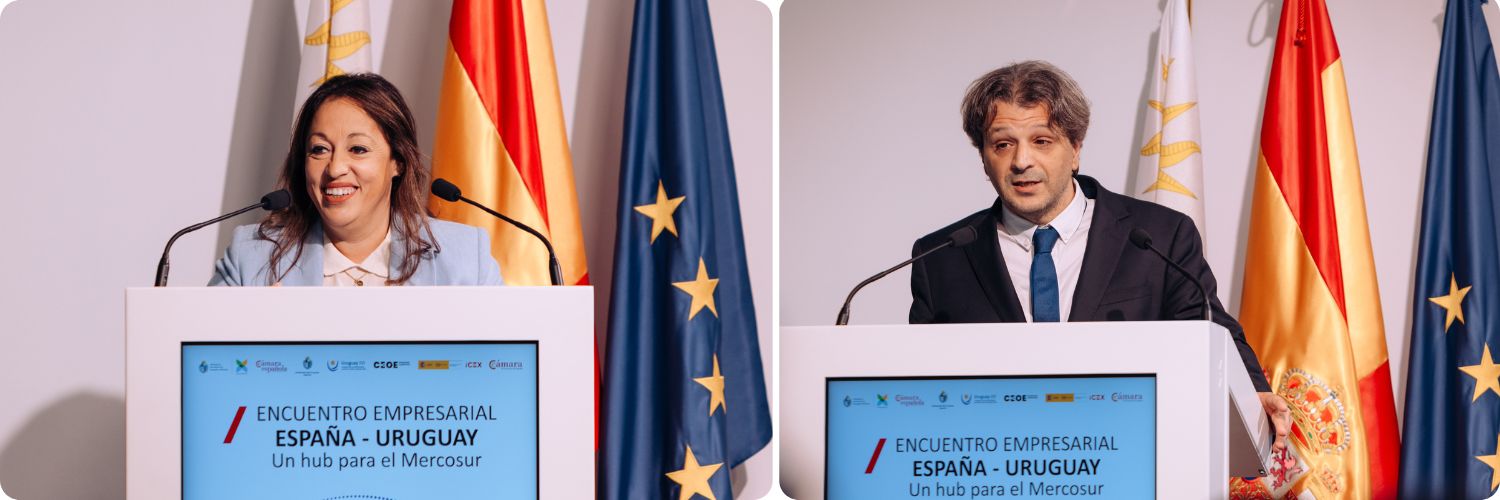
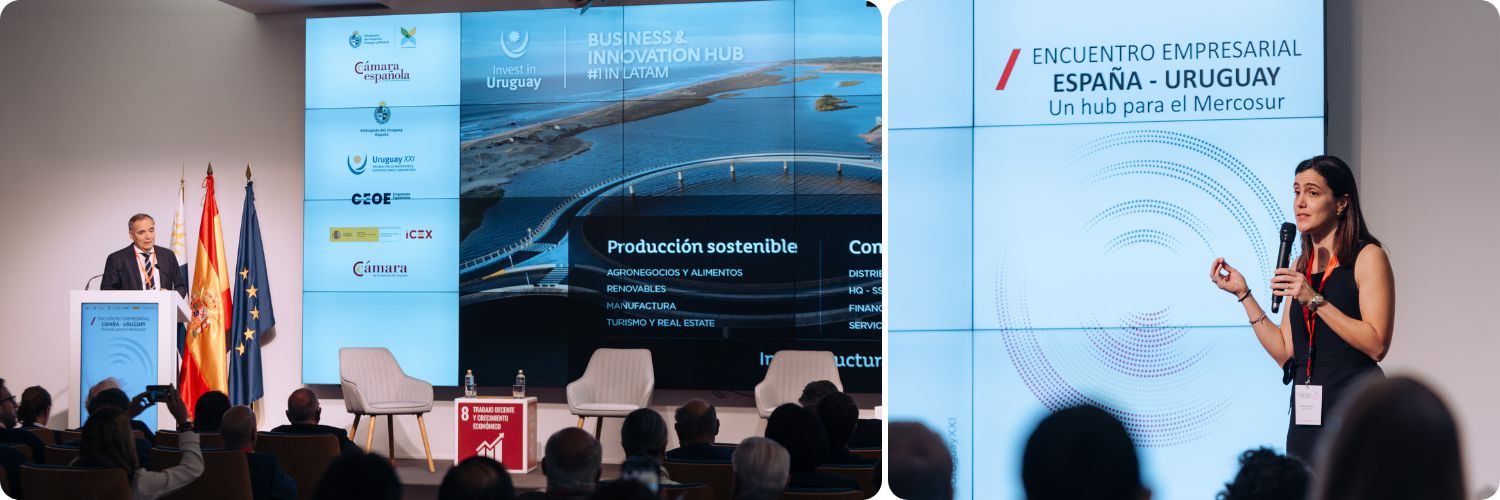
Martín Mercado, Deputy Executive Director of Uruguay XXI, thanked the organizing institutions for their collaborative efforts and the Spanish and Uruguayan companies in attendance for their participation. He noted that the event took place at “an opportune moment” to strengthen bilateral economic ties and emphasized that trade agreements typically drive companies’ international expansion. “Data from the Inter-American Development Bank (IDB) show that when the European Union signs trade agreements, its companies expand into those markets and accelerate European foreign direct investment,” he noted.
Spanish Companies Highlight Confidence and Predictability
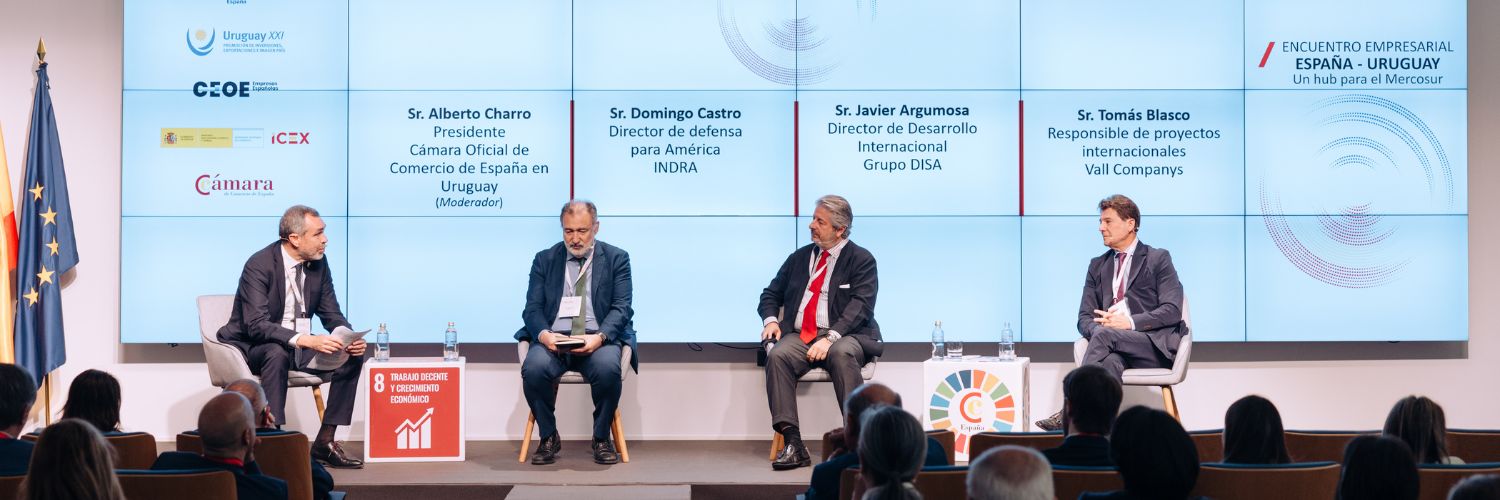
One of the highlights of the event was the panel featuring representatives from Spanish companies with operations in Uruguay, who shared their experiences with investment and regional expansion from the country.
Javier Argumosa, Director of International Development at Grupo DISA, explained that the company decided to invest in Uruguay after identifying a favorable environment for its internationalization process. “When you arrive, you feel at home. We loved the country, the security, and the accessibility of the institutions,” he noted. He added that economic and institutional stability was a key factor in finalizing the investment, even in the midst of the pandemic.
INDRA’s Director of Defense for the Americas, Domingo Castro, explained that the company has evolved from a strategy focused exclusively on the Uruguayan market toward a regional vision. “We have already begun to view Uruguay not as a domestic market, but as a regional hub,” he stated. The executive particularly highlighted the free trade zone regulations, regulatory predictability, and the quality of human resources as key factors for establishing a strategic maintenance and support center for critical systems in the country that will serve all of South America.
Castro also emphasized the level of local talent. “This is the first time Indra has developed an industrial operation of this type without relocating Spanish executives. It is Uruguayan executives who are leading the project,” he said.
“We made the mistake in the past of thinking that any investment in Uruguay required relocating a large workforce there due to a lack of, perhaps, training. (...) Uruguayan human capital and the Uruguayan academic system are at European standards,” he added.
In turn, Tomás Blasco, head of international projects at Vall Companys, noted that Uruguay was not initially among the group’s priority expansion destinations. However, the combination of stability, an export-oriented focus, and favorable conditions for business development ultimately tipped the scales. The executive also highlighted the quality of Uruguayan business partners as one of the attributes the company valued most when finalizing its entry into the country.
Uruguay as a Gateway to the Region
Throughout the day, business leaders and officials agreed on a common message: Uruguay is increasingly positioning itself as a strategic platform for accessing Mercosur and Latin America.
“Uruguay is not just Uruguay; it is the region,” summarized Castro when referring to the advantages the country offers for exporting services and developing regional operations.
From the Spanish Confederation of Business Organizations, Vice President Miguel Garrido de la Cierva reinforced this view by noting that Uruguay has established itself as one of the “most reliable, attractive, and predictable” countries in Latin America and that the European Union-Mercosur agreement represents a strategic opportunity to strengthen economic ties between both regions.
The relationship between Spain and Uruguay is currently experiencing a period of strong dynamism and finds in stability, trust, and economic complementarity the foundations for a new phase of joint growth.