
- Home
- About us
- News
- Events
- EXPORT Export
- BUY Buy
- INVEST Invest
- COUNTRY BRAND Country Brand
-
INFORMATION CENTER
Information center
InformationCenterInformationCenterReports Country reports Department reports Foreign trade reports Product-Destination worksheet Sectors reports Work documentsStatistical information Classification Uruguay XXI Exports Imports Innovative National Effort Macroeconomic Monitor Tools Buyers Exporters Investors
- Contact
-
Languages
The EU-Mercosur agreement opens up new business opportunities for Uruguay
The executive director of Uruguay XXI announced a new platform to help companies take advantage of the benefits of the agreement
 Publication date: 05/06/2026
Share:
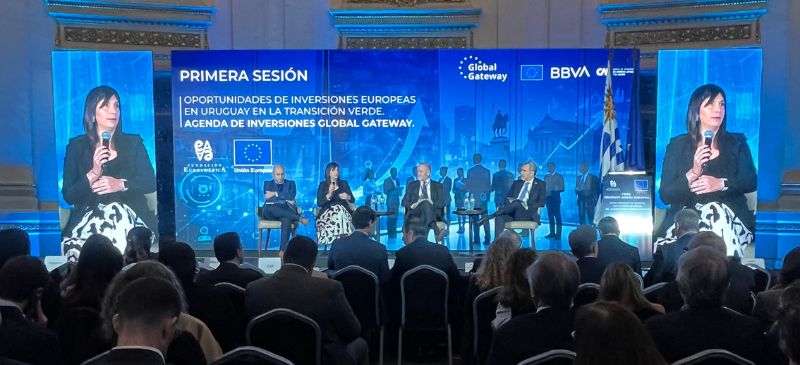
The provisional implementation of the agreement between the European Union (EU) and Mercosur was the central focus of the Uruguay–European Union Forum “New Business Horizons with the Implementation of the EU-Mercosur Agreement,” which brought together officials, experts, and business representatives in Montevideo to discuss the opportunities emerging for trade, investment, and cooperation between the two blocs.
The event, organized by the Euroamerica Foundation and the European Union Delegation in Uruguay, was attended by political and economic leaders from both regions, including Uruguay’s Minister of Foreign Affairs, Mario Lubetkin.
Representing Uruguay XXI, Executive Director Mariana Ferreira participated in the panel dedicated to European investment opportunities in Uruguay. During her remarks, Ferreira emphasized that the provisional entry into force of the agreement represents a paradigm shift for the economic relationship between the two blocs.
In particular, she noted that the agreement opens opportunities especially for Uruguayan micro, small, and medium-sized enterprises (MSMEs). She noted that MSMEs accounted for 61% of Uruguayan companies exporting to the European Union, although they represented only 3% of the total export value to that destination.
In this context, she announced that Uruguay XXI is developing a specific platform on the European Union-Mercosur Agreement to provide companies with access to practical information and tools that will allow them to take advantage of new trade opportunities.
The initiative aims to translate the provisions of the agreement into useful information for business decision-making and to help identify concrete export opportunities to the European market.
“The challenge for companies is not just knowing that a preference exists, but understanding when it applies, under what conditions, and what documentation they must submit,” Ferreira stated.
The tool will allow for personalized consultation on the treatment applicable to each product. By identifying a specific tariff heading, companies will be able to access detailed information on the current tariff and its phase-out schedule, available preferential access quotas, applicable rules of origin, and the requirements set by the European Union for entering that market.
Additionally, it will centralize information in a single location, making it easier for exporters and potential exporters to consult and understand.
As Ferreira explained, the goal is for companies to have clear and actionable information to plan their business strategies, adapt to new regulatory requirements, and effectively take advantage of the preferences that will become available with the implementation of the agreement.
“The goal is to transform a complex agreement into concrete and actionable information so that more companies, especially MSMEs, can take advantage of the opportunities generated by preferential access to the European market,” he said.
Currently, the European Union is the third-largest destination for Uruguayan goods exports, with products such as pulp, meat, and rice leading sales. It is also the main source of foreign direct investment in Uruguay, accounting for nearly 40% of the total received by the country. In addition, more than 300 European companies operate in Uruguay and generate approximately 30,000 jobs.