
- Home
- About us
- News
- Events
- EXPORT Export
- BUY Buy
- INVEST Invest
- COUNTRY BRAND Country Brand
-
INFORMATION CENTER
Information center
InformationCenterInformationCenterReports Country reports Department reports Foreign trade reports Product-Destination worksheet Sectors reports Work documentsStatistical information Classification Uruguay XXI Exports Imports Innovative National Effort Macroeconomic Monitor Tools Buyers Exporters Investors
- Contact
-
Languages
Uruguay XXI Strengthens Its International Agenda to Expand Opportunities for Uruguayan Companies
Pablo Pereira, Export Promotion Manager at Uruguay XXI, participated in a panel on competitiveness and global markets at the Forbes Agro Summit
 Publication date: 18/06/2026
Share:
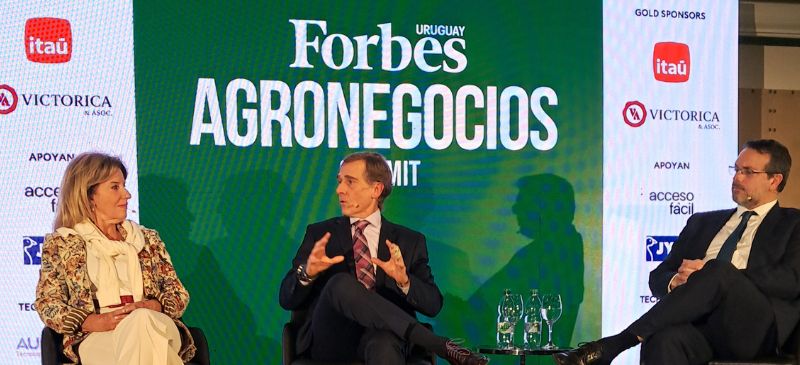
International integration, competitiveness, and access to new markets were among the central themes of the panel *“Competitiveness, Investment, and Global Markets,”* held during the Forbes Agro Summit. The event brought together representatives from the public and private sectors to discuss the challenges and opportunities facing Uruguay in an increasingly dynamic global environment.
Moderated by journalist Andrés Oyhenard, the panel featured Ricardo Beluga, Director General for International Economic Affairs at Uruguay’s Ministry of Foreign Affairs; agribusiness entrepreneur Patricia Damiani; and Pablo Pereira, Export Promotion Manager at Uruguay XXI.
During his remarks, Pereira highlighted Uruguay XXI’s role in promoting exports, identifying trade opportunities, and supporting Uruguayan companies in their internationalization efforts.
“Our role is to promote export growth and diversification while fostering an export-oriented culture. One of our main activities is supporting the participation of Uruguayan companies in international trade fairs across a wide range of sectors,” he said.
In this context, he explained that the agency follows a sector-based approach to identify strategic markets and assist companies with international promotion activities. Among recent initiatives, he mentioned Uruguay XXI’s participation in activities in Spain and Brazil, supporting both technology companies and businesses across the food industry.
Pereira also noted that the European Union currently holds a priority position on the agency’s international promotion agenda.
“We are carrying out many activities in the European Union to position Uruguay, showcase the opportunities the country offers, and attract investment,” he said.
The Export Promotion Manager also welcomed the conclusion of the Mercosur-European Union agreement, describing it as a milestone after nearly two decades of negotiations.
In this context, he explained that Uruguay XXI is working to ensure that companies—particularly small and medium-sized enterprises—can fully benefit from the opportunities created by the agreement.
To that end, the agency is developing a platform that will allow exporters to access detailed information on market access conditions for their products.
“The platform will allow companies to determine whether a product is subject to quotas or tariffs, understand tariff reduction schedules, identify applicable regulations, and review the sanitary requirements needed to export,” he explained.
Although the focus of his presentation was export promotion, Pereira also highlighted Uruguay XXI’s role in generating strategic information for companies, investors, and public institutions, as well as attracting investment and strengthening Uruguay’s international positioning.
“Through our investment promotion efforts, we are working to position Uruguay as a regional hub—not only for production and distribution, but also as a center for services,” he said.
At the conclusion of the panel, Pereira emphasized that trade liberalization, international promotion, and stronger competitiveness are key factors in expanding the country’s growth opportunities.
“The agreements that are being signed—and those still to come—are positive developments because they create new opportunities and strengthen the country’s competitiveness,” he concluded.