
- Home
- About us
- News
- Events
- EXPORT Export
- BUY Buy
- INVEST Invest
- COUNTRY BRAND Country Brand
-
INFORMATION CENTER
Information center
InformationCenterInformationCenterReports Country reports Department reports Foreign trade reports Product-Destination worksheet Sectors reports Work documentsStatistical information Classification Uruguay XXI Exports Imports Innovative National Effort Macroeconomic Monitor Tools Buyers Exporters Investors
- Contact
-
Languages
Uruguay XXI highlighted regional integration as a tool for promoting productive development
Executive Vice Director Martín Mercado participated in an ECLAC panel on productivity, innovation, and regional integration
 Publication date: 15/07/2026
Share:
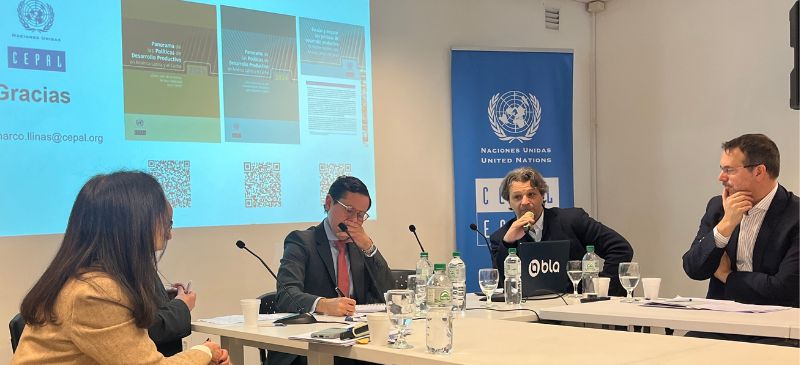
As part of the Industry Week, organized by the Ministry of Industry, Energy, and Mining (MIEM), the executive vice director of Uruguay XXI, Martín Mercado, participated in the panel discussion “Productive Development and Regional Integration: An Agenda from Latin America and the Caribbean,” convened by the Economic Commission for Latin America and the Caribbean (ECLAC). The event brought together national officials and experts to discuss how to strengthen productivity and regional integration.
Following a presentation by Marco Llinás, Director of ECLAC’s Division of Productive and Business Development, the discussion continued with a panel featuring Daniel Olesker, Undersecretary of the MIEM; Ricardo Baluga, Director General for International Economic Affairs at the Ministry of Foreign Affairs; and Mercado. Olesker highlighted the need to promote an industrial policy with a regional perspective and to strengthen value chains among countries, while Baluga emphasized the importance of advancing infrastructure, regulatory convergence, and institutional coordination to deepen integration.
In this context, Mercado addressed the role that promotion agencies can play in deepening productive integration. He noted that a substantial part of Uruguay XXI’s work is based on market intelligence and argued that this knowledge must be complemented by greater cooperation among counterpart institutions. “We have bilateral exchanges with many agencies, but not as much regional integration. We need to build those links at the regional level,” he stated.
As an example of tools that can facilitate this process, he highlighted the experience of the Single Window for Foreign Trade (VUCE) and the Single Window for Investment (VUI). He noted that Uruguay already has interoperability with Chile—a mechanism that streamlines trade processes—and emphasized the need to advance similar initiatives with Mercosur countries.
Mercado also maintained that productive integration requires specific policies and a clear definition of the sectors with the greatest potential for integration into regional value chains. The challenge, he said, lies in “identifying sectors capable of integrating” and focusing efforts on improving productivity, quality, and human capital development to strengthen their competitiveness.
The deputy executive director reviewed some of the initiatives Uruguay is promoting to attract investments with higher technological content. He explained that Uruguay XXI, together with the Ministry of Economy and Management (MIEM) and other public agencies, coordinates the Uruguay Innova program, which aims to align innovation policies and create a favorable environment for higher value-added investments. He also highlighted that the agency works continuously with the Ministry of Foreign Affairs and other institutions to “sharpen the focus” on identifying strategic markets for exports and attracting investment.
Regarding the agreement between Mercosur and the European Union, Mercado noted that Uruguay XXI was designated as the focal point for small and medium-sized enterprises and announced the development of a portal that will make the treaty easier to understand. The platform will compile information on tariffs, tariff elimination schedules, and trade opportunities, with the goal of making the agreement’s content more accessible to SMEs and supporting them as they integrate into value chains and gain access to the European market. As he explained, the initiative aims to translate a highly complex trade agreement “into more down-to-earth language” to make it easier for companies to take advantage of it.