
- Home
- About us
- News
- Events
- EXPORT Export
- BUY Buy
- INVEST Invest
- COUNTRY BRAND Country Brand
-
INFORMATION CENTER
Information center
InformationCenterInformationCenterReports Country reports Department reports Foreign trade reports Product-Destination worksheet Sectors reports Work documentsStatistical information Classification Uruguay XXI Exports Imports Innovative National Effort Macroeconomic Monitor Tools Buyers Exporters Investors
- Contact
-
Languages
Spanish companies identified opportunities in infrastructure and urban mobility in Uruguay
At an event organized by ICEX and the Spanish Embassy, the deputy executive director of Uruguay XXI highlighted reinvestment as the most reliable indicator of Uruguay's predictability
 Publication date: 22/06/2026
Share:
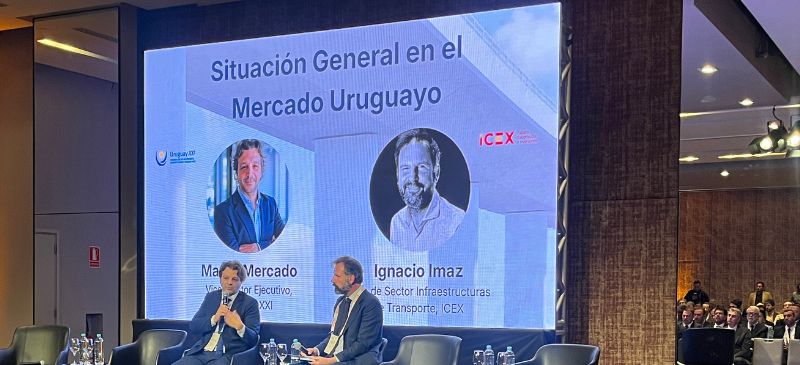
Uruguay XXI, the government agency responsible for promoting investment, exports, and the country’s image, participated in the Conference on Transportation Infrastructure and Urban Mobility in Uruguay. The event brought together national and departmental authorities, representatives from the European Union, multilateral organizations, and a prominent business delegation from both countries.
The meeting, organized by ICEX—the Spanish agency for internationalization—and the Spanish Economic and Commercial Office in Montevideo, included a mission of 16 leading Spanish companies, notably ADIF (the Spanish Railway Infrastructure Administrator) and the Madrid Municipal Transportation Company.
The event explored management models, financing mechanisms, and key projects in the areas of rail, road, and sustainable metropolitan transportation in Uruguay.
During the opening ceremony, Spain’s ambassador to Uruguay, Javier Salido Ortiz, described the current moment as “historic,” given the opportunities opened up by the European Union–Mercosur Agreement, which will allow Uruguay to position itself as the natural gateway to the region for European companies. He also praised the country’s legal certainty and its ability to build national consensus that transcends political cycles.
“Spain is the leading foreign investor in Uruguay, with a stock of investment exceeding US$7.5 billion and more than a hundred companies with a stable presence across all sectors,” the diplomat noted.
The Value of Aftercare and the Country’s Attributes
During his remarks in the session on the general market situation, Martín Mercado, Deputy Executive Director of Uruguay XXI, reviewed the tools the agency provides to facilitate the entry and subsequent expansion of foreign capital within the country.
Mercado emphasized the agency’s post-investment support (aftercare) and noted that the growth of firms already established in Uruguay is the best reflection of the local business climate.
“A large number of companies end up expanding and increasing their presence in our country. That’s where they also turn to us for support. Perhaps the reinvestment by companies—primarily Spanish ones—is the best indicator, beyond any macroeconomic stability indicators I might mention,” stated Mercado.
The official explained that there are currently some 159 companies of Spanish origin identified in Uruguay, which provide employment for 10,000 people and cement Spain’s position as a strategic trading partner accounting for approximately 40% of the country’s stock of foreign direct investment (FDI).
He maintained that the key factors driving this investment flow and setting Uruguay apart in the region are the predictability and stability provided by a clear regulatory framework, accompanied by well-established tax incentives such as those proposed by the Investment Promotion Law, which has been in effect for more than three decades. He also highlighted the nationally unified tax system, which simplifies business operations; the institutional proximity that facilitates contact with different levels of government; and the quality of local talent—one of the country’s main assets and a key factor in companies’ decisions to establish themselves in Uruguay and expand their services throughout the region from there.
Mercado agreed on the positive impact of the European Union–Mercosur Trade Agreement and noted that—according to data from the Inter-American Development Bank (IDB)—countries that sign such agreements experience an exponential increase in foreign direct investment in the medium term due to the infrastructure and logistics demands generated by the opening of markets.
The event also featured technical panels composed of representatives from the National Railway Transportation Directorate, the National Highway Directorate, and the National Transportation Directorate, along with experts from financial and multilateral organizations.